
Nine objects, picked by members of the collections team
Behind every object at Mount Vernon is both a story from the past and the care of those who steward it today. Built over more than a century and a half through the diligence of the Mount Vernon Ladies’ Association, the collection is one of the most significant assemblages of American historical artifacts.
Here, explore nine objects, chosen by members of Mount Vernon’s collections team, that hold personal meaning for the professionals who care for them.
1
Lady’s Writing Table
George Washington purchased this desk from the French minister to the United States for Martha Washington to use during the presidency. Called a bonheur du jour, it was used by upper-class women to answer correspondence. The mahogany and white oak desk has several compartments, as well as a writing flap that folds out specifically for this purpose. Details such as secret compartments and a marble top are elements that make me wish I could own a similar example for myself.
Notable: Two letters between George and Martha Washington were found behind one of the drawers; they are two of only three known to have survived.
— Megan Little, registrar

Made by Victor-Jean-Gabriel Chavigneau, France, 1787–1789 [W-220]. Purchase, 1939. (Photo By Gavin Ashworth / MVLA)
2
Portrait of Louis XVI
France was a vital ally to the fledgling United States, and French ambassador Jean-Baptiste Ternant presented President Washington with this portrait in 1791 as a gift from the king. Washington displayed the print in his Philadelphia residence and later in the New Room at Mount Vernon. Today it hangs mere steps away from the key to the Bastille—an emblem of an event that initiated the French Revolution and led to the toppling of the same monarch. Together with the key, the portrait embodies a complex and quickly evolving global history of revolution in the early 1790s in which Washington was a central figure.
Notable: The frame around the print is original. The monarch’s royal crest and monogram appear at the top, while G and W, along with Washington’s family crest, are affixed at the bottom.
— Jill Vaum Rothschild, associate curator

Louis seize, roi des français, restaurateur de la liberté, engraved by Charles-Clément Bervic, after Antoine-François Callet, France, 1790 [W-767/a-b]. Purchase, 1939. (Photo by Gavin Ashworth / MVLA)
3
Hair Locket
The Mount Vernon collection contains more than 50 pieces of mourning jewelry and other objects with hair from George Washington, Martha Washington, and their family members. Hair was placed in rings, lockets, and brooches, often in braided or decorative patterns. These objects were a way to showcase love and admiration for a deceased loved one. Jewelry containing George Washington’s hair was also considered a relic of a great leader.
Notable: This locket features the hair of two people, George Washington and Zachary Taylor, the first and 12th U.S. presidents.
— Madeline Altobelli, assistant collections manager
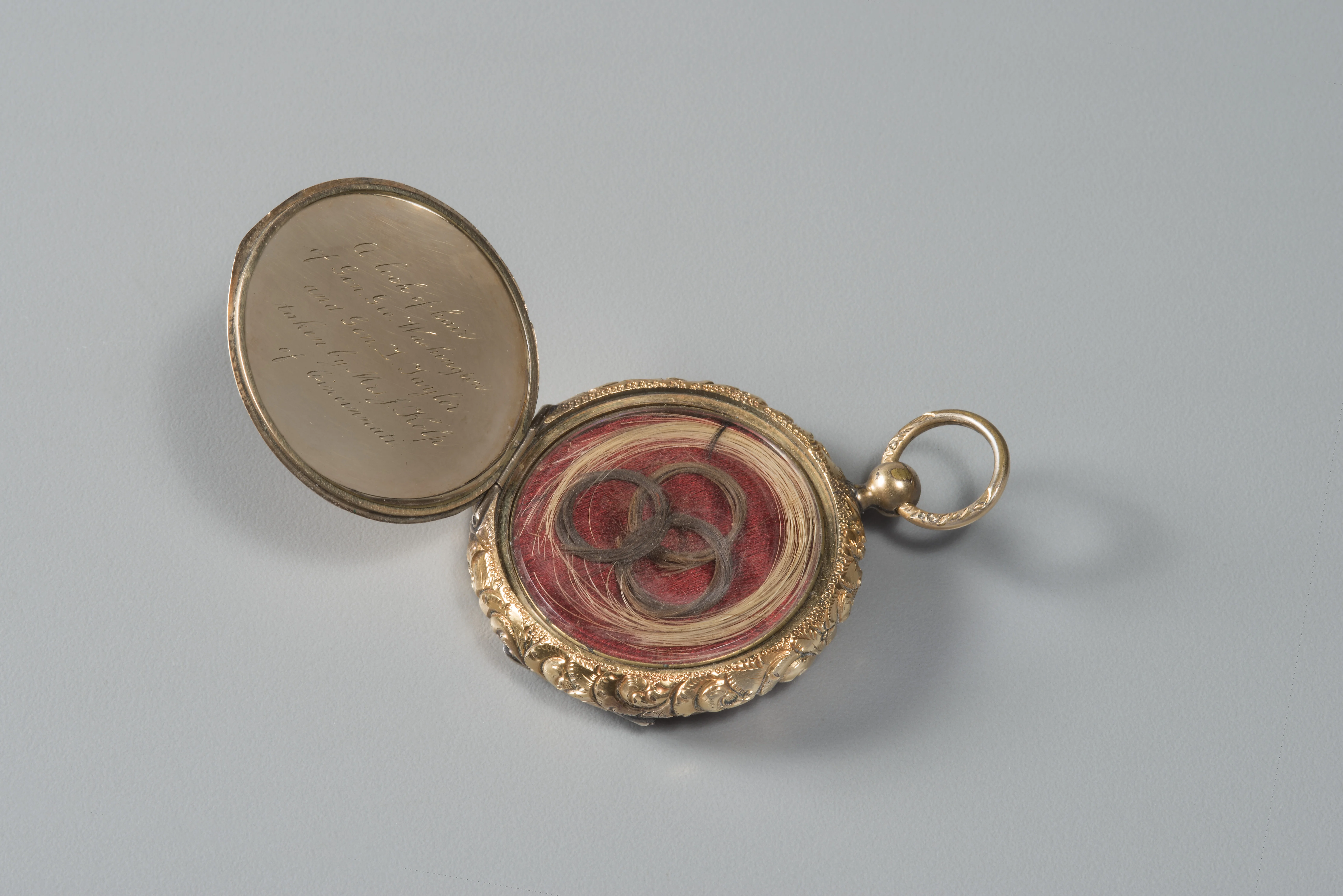
Unknown maker, United States, about 1850 [M-1495]. Gift of Thomas P. Guerin and Catherine Guerin Gill, 1948. (Photo by Gavin Ashworth / MVLA)
4
Waffle Iron
This item, made of hinged cast iron plates meant to be filled with batter and heated atop a stove or open flame, provides a unique, historical look at an object many of us have in our kitchens. I myself am reminded of my own childhood, when my parents would make pancakes in the shape of my and my sibling’s initials. Technology has changed, but the artful presentation of food has a long history.
Notable: This heart-shaped waffle iron is one of two listed on the probate inventory taken after George Washington’s death. It would have been used by the enslaved cooks—Doll, Hercules Posey, Nathan, and Lucy—who prepared all the meals at Mount Vernon.
— Madi Garrett, assistant collections manager

Unknown maker, United States, 18th century [W-1057]. Purchase, 1939. (Photo by Anne Kingery / MVLA)
5
Head Measure in Washington’s Hand
This scrap of paper written by Washington containing the “head measure of Giles and Paris” represents a rare glimpse into the physical presence of the enslaved beyond what we find in the archaeological record. The paper bears two lines representing the circumference of enslaved coachmen Giles’s and Paris’s old caps. These measurements were then used to make new caps for them, which would feature “fuller and thicker tassels.” The note on the paper explains which lines represent Giles and which Paris.
Notable: Textiles and works on paper (even brief notes like this) can only be exhibited for short periods of time due to the risk of light damage, including fading of inks and pigments. To preserve such items, we rotate them off view every six months.
— Caroline Fowler, assistant collections manager

Written by George Washington, United States, 1790 [W-2079]. Gift of R. Keith Kane, 1957. (Photo by Gavin Ashworth / MVLA)
6
Terrestrial Floor Globe
Washington’s 28-inch globe in a mahogany stand was crafted by the globemaker to King George III. The printed curved map sections known as gores were aligned, adhered, and watercolored onto the globe’s papier-mâché and plaster core. Cartographers could update their globes to include new geographical discoveries by making changes to the copperplates used in printing the gores. Washington undoubtedly consulted it throughout his presidency and then placed it in his study at Mount Vernon.
Notable: It is among the few items that have remained at Mount Vernon since Washington’s lifetime, leaving the property only for conservation work.
— Linda Landry, collections conservator

Made by Dudley Adams, engraved by John Senex, England, 1789–1790 [W-166]. Transferred to the Mount Vernon Ladies’ Association through the generosity of John Augustine Washington III, 1860; conservation courtesy of T. Eugene and Joan H. Smith. (Photo by Gavin Ashworth / MVLA)
7
Embroidered Piece
“Sacred to the Memory of Washington” depicts Liberty sitting on the British lion and reviewing the texts of the U.S. Constitution and the French Rights of Man. Behind her is a monument to Washington. Elizabeth Miltimore’s political commentary, worked in silk embroidery and watercolor, is one example of the ways in which young women in the early American republic expressed their creativity and knowledge within the constraints of a patriarchal society. These works offer insights into the lives and values of their makers, who were later marginalized and excluded from the art historical record.
Notable: The artist drew inspiration for this piece from various printed sources. The overall design is based on an unidentified print that relates to both the American and French Revolutions, as evidenced by the combination of English and French phrases stitched throughout.
— Lindsay Chase, assistant collections manager

Made by Elizabeth Miltimore, after Enoch Gridley and John Coles, Jr., United States, about 1809 [M-6072]. Purchased by the A. Alfred Taubman Acquisition Endowment Fund, 2024. (Photo by Gavin Ashworth / MVLA)
8
Artist’s Paint Box
With its polished mahogany, delicate shell inlay, and brass pulls, this set is a beautifully crafted work of art in itself. But its contents are just as compelling: 37 watercolor blocks, a palette, mixing bowls, and more. The box offers a direct link to the hand of the artist: Eleanor “Nelly” Parke Custis, Washington’s granddaughter and an avid painter. Two centuries later, it still sparks the imagination and tempts artists like me—I’d love to grab a brush and dive in.
Notable: Many of the historical pigments in the box are recognizable and available to the modern artist; paints such as burnt and raw sienna, burnt umber, yellow ochre, sap green, Prussian blue, cobalt blue, Antwerp blue, ultramarine, light red, Vandyke brown, sepia, indigo, neutral tint, and lamp black can all be purchased in your local art store.
— Brady Stroyke, director of collections management and exhibitions
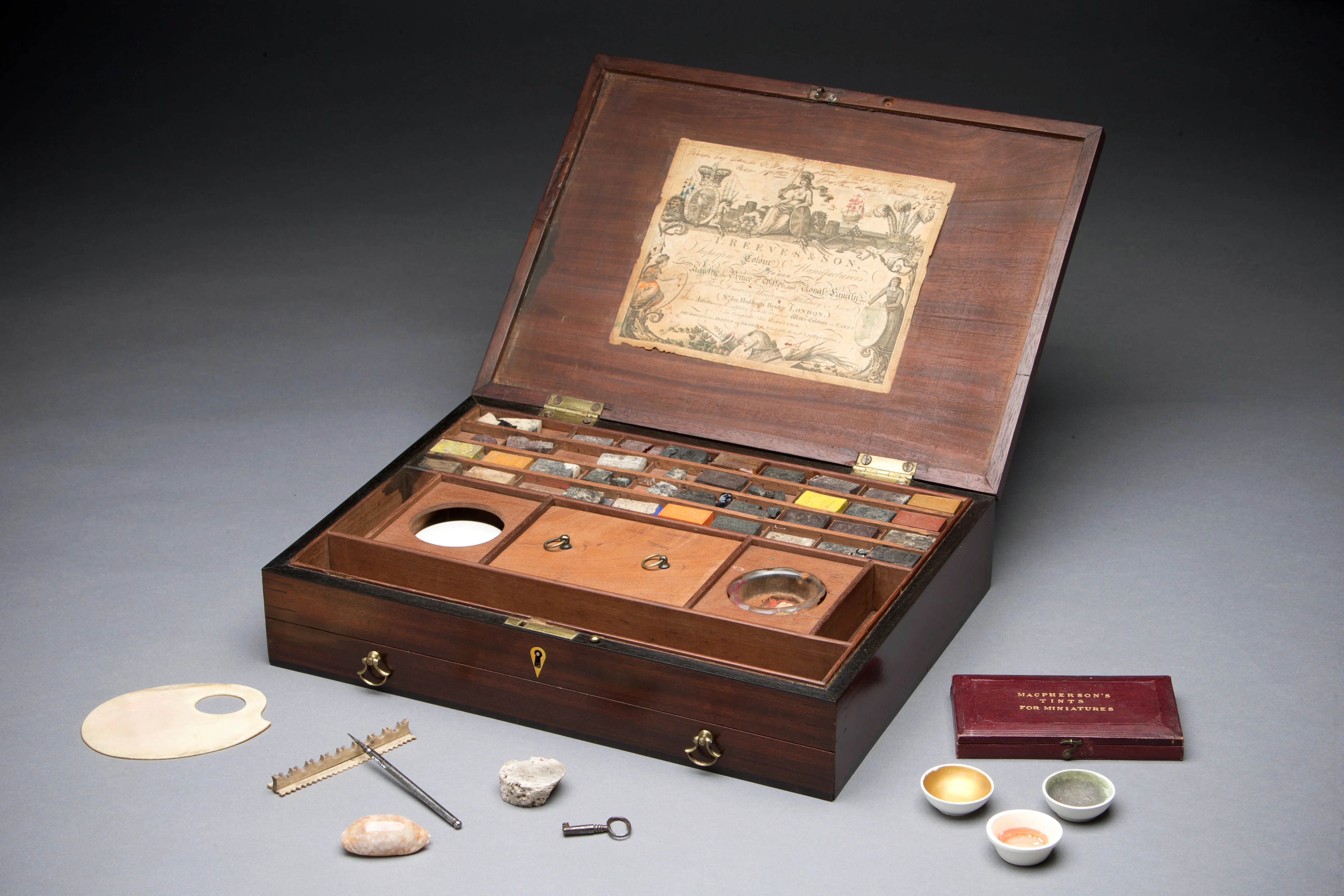
Made by Thomas Reeves & Son, London, England, about 1790–1797 [W-5326/A-U]. Gift of Jess and Grace Pavey Fund, 2013. (Photo by Mark Finkenstaedt / MVLA)
9
Needle Lace Sampler
This sampler passed through Martha Washington to her descendants and then to Mount Vernon, but it was created by a now unknown maker, almost certainly a female, in 17th-century England and then brought to Virginia. Of all the things someone could have chosen to pack when immigrating to a foreign land, she chose something of exquisite beauty. It reminds me of the fundamental human need for art.
Notable: Despite the losses, close observers can still follow the maker’s improving skill from the top band to the bottom band—the evenness of the stitches and tension improve dramatically.
— Amanda Isaac, chief curator, fine and decorative arts

Unknown maker, England, about 1610–1670 [W-2684]. Gift of Mrs. Walter Gibson Peter, Jr., in memory of Agnes Peter Mott, 1975. (Photo by George Brown / MVLA)
Explore the Collection
Learn more about the fascinating objects in Mount Vernon's collection.