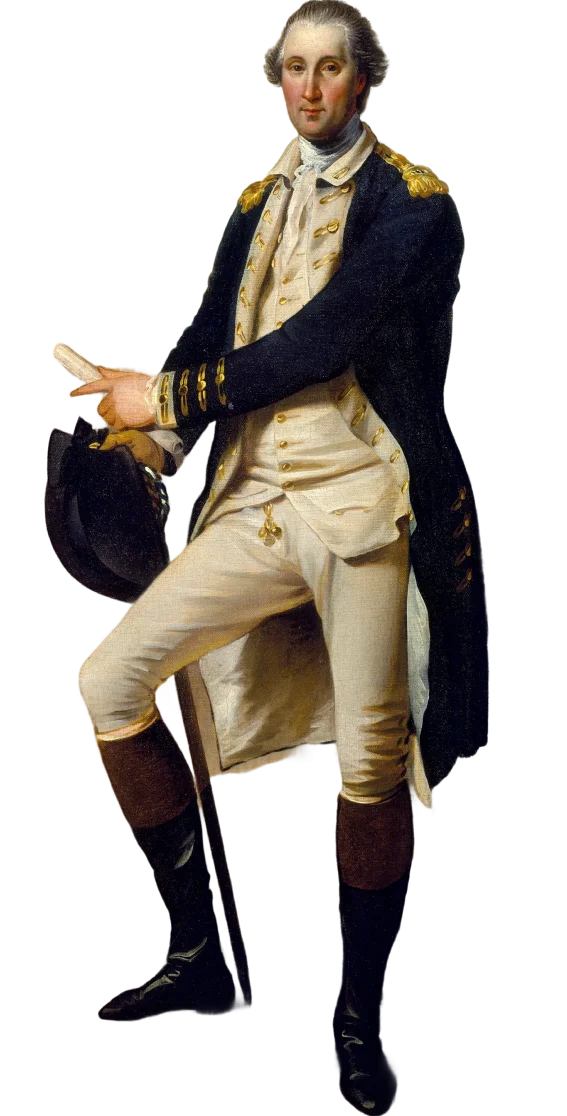
In his final years at Mount Vernon, George Washington cemented a legacy that would endure far beyond his lifetime.
After two terms as president, George Washington returned home with plans to improve agricultural practices at Mount Vernon, hoping his new ideas could offer a model of farming that did not rely on slavery. He also took a leading role in the creation of a new federal capital along the Potomac, which would become the District of Columbia and bear his name.
Yet these ambitions would be cut short. Washington’s sudden death in 1799 prompted an outpouring of national grief, uniting Americans in remembrance of a leader who had guided the country through its founding. In his final act, Washington used his will to free those he enslaved.
The decision secured Washington’s legacy as the Father of His Country—a legacy defined by leadership, civic duty, and an evolving vision of liberty.

Planning the Capital
George Washington played a central role in establishing the nation’s new capital, selecting its site along the Potomac and guiding the creation of the city that would bear his name.
Learn More
Distillery
Washington never stopped innovating and developing methods that could serve as models for the people of the new nation. After the presidency, he immediately launched a new business at Mount Vernon, building one of the largest distilleries in the nation.
Learn More
Changing Views on Slavery
Washington's views on the use of enslaved labor continued to evolve. After the presidency, he sought a model of farming that did not rely on slavery, and he hoped the state legislature would move to gradually end slavery in Virginia.
Learn More![An artist's depiction of George Washington's final moments. - Life of George Washington: The Christian, lithograph by Claude Regnier, after Junius Brutus Stearns,1853. Gift of Mr. and Mrs. Robert B. Gibby, 1984 [WB-55/A1], Mount Vernon Ladies' Association, Mount Vernon, VA.](https://mtv-main-assets.mountvernon.org/files/styles/feature_image_link_list/s3/resources/ct-6515-6.jpg.webp?VersionId=l28puiKAaAk2D4IQua67WgyF2_KfwW_R&h=648d9ec5&itok=GpGytCWy)
The Death of Washington
Less than three years after his retirement from public life, Washington suddenly fell ill and died. A stunned nation grieved together. Washington’s extraordinary leadership had won American independence and secured the Union. Many eulogies and memorials remembered a man whose life had exemplified service to his country.
Mourning Washington
Word of George Washington’s death traveled rapidly through newspapers and networks. Congress designated Washington’s birthday, February 22, as a national day of mourning. Public eulogies and memorials for Washington took place on that day throughout the country. There were 231 known commemorations.
Learn More
Washington's Will
From his deathbed, George Washington directed Martha to burn one of his two wills. The surviving will, a 29-page document, reveals much about his deeply held beliefs regarding slavery, education, and the cause for which he fought.
His will promised freedom by the terms of Virginia law to all the enslaved people legally bound to his estate and other landholdings. He also granted funds for numerous educational institutions and expressed his hope that the founding of a national university might help unify the country. He gave his nephews his swords, advising them that they should use the weapons only in self-defense or in defense of their country and its rights.
The End of Slavery for Many at Mount Vernon
Washington’s ideas about slavery evolved over his lifetime. While he did not lead a public effort to abolish slavery, he did act privately. In his will, he freed more than 100 people, supported those too old to work, and specified apprenticeships and other education for youth under 25. Washington hoped other American slaveholders would follow his example. They did not.
His will immediately freed his former valet, William Lee, and, upon Martha Washington’s death, would end slavery for all 123 people considered his property. He could not free the 154 people at Mount Vernon who belonged to the Custis estate.
Eulogies
People throughout the nation reacted to Washington’s death. Communities made public statements, and friends shared their thoughts with each other in private letters.
Political figures and spiritual leaders, as well as the men and women who knew him best, reflected on his passing through their words.

"Commemoration of Washington," engraved by John James Barralet, c. 1800. (Public domain)
First in war, first in peace, and first in the hearts of his countrymen, he was second to none in the humble and endearing scenes of private life.- Henry “Lighthorse Harry” Lee III, December 26, 1799