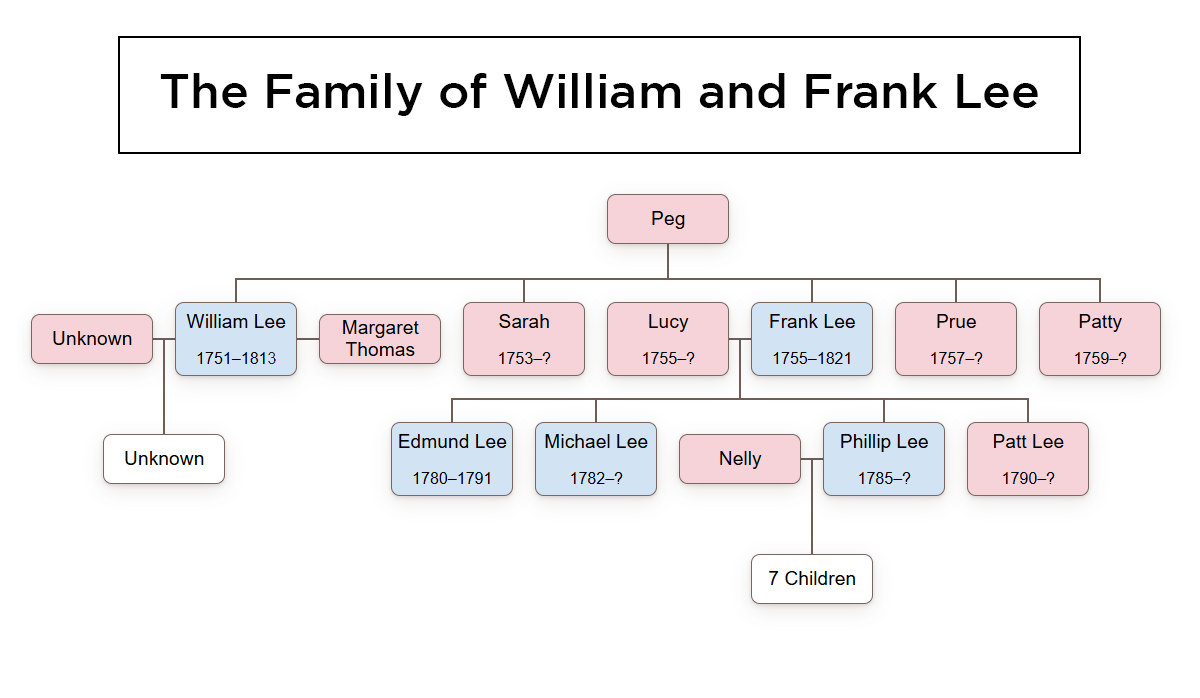
Brothers William and Frank Lee were two of the most visible enslaved people who worked at Mount Vernon during Washington’s life. William was George Washington’s personal valet, and accompanied him on most of his trips and throughout the American Revolution until injury rendered him disabled in the 1780s. Frank was Mount Vernon’s head butler, responsible for much of the workings of the house. Washington purchased the brothers in October 1767 from Mary (Smith) (Ball) (Lee) Smith, the widow of John Lee of Cabin Point Plantation, Westmoreland County, who had died earlier that year. Probate records generated by John Lee’s estate reveal that William and Frank’s mother was named Peg, and that they had at least three other siblings: Sarah, Prue, and Patty. The siblings and their mother were split up by the October sale, and with the exception of William and Frank–the only two to be purchased together–it is unclear if they ever saw each other again.
John Lee of Essex County and Cabin Point
John Lee (1724-1767) was the oldest son of Henry Lee of Lee Hall (1691-1747) and Mary (Bland) Lee (1704-1764). He lived in Essex County and at Cabin Point in Westmoreland County and was the older brother of Henry Lee (father of “Light Horse Harry” Lee), Laetitia (Lee) Ball, and Richard “Squire” Lee of Lee Hall. He was the first cousin, though his father Henry Lee’s brother Thomas Lee, of the Lees of Stratford Hall: Philip Ludwell Lee, Hannah Ludwell (Lee) Corbin, Thomas Ludwell Lee, Richard Henry Lee, Francis Lightfoot Lee, William Lee, and Arthur Lee.1 He married Mary (Smith) Ball, the widow of Jesse Ball, a cousin of Washington’s mother Mary (Ball) Washington.2
Peg, the Mother of Frank and William
Only some of William and Frank’s mother’s life can be reconstructed. Peg was described as still being young in 1767, likely in her 30s.3 John Lee had inherited her from his father Henry Lee when the latter died in 1747, when Peg was probably just a teenager. In that year, she was living at Henry Lee’s main Lee Hall plantation, where she possibly worked in or near the house.4 Many other enslaved people are mentioned in these probate materials, but there is no indication from these records of exactly how old Peg was, her work assignments, or who her family may have been. It may be significant that there were several women named Prue and Sarah, as well as an older Patty, also listed in Henry Lee’s probate.
Henry Lee initially willed Peg to his daughter Laetitia, likely intending her as a lady’s maid.5 After Laetitia’s marriage to William Ball, however, Lee inserted an amendment which changed Peg’s fate: she would instead be inherited by John Lee, Henry Lee’s oldest son.6 She was one of only three people from Henry Lee’s main Lee Hall plantation who would be transferred to John Lee. The majority of the enslaved individuals he acquired came from his father’s Machodoc Plantation, which he also inherited.7 This meant that on Henry Lee’s death, Peg was removed from the community she had grown up in, likely leaving behind family members.
Peg’s first known child, William, was born in about 1751, a few years after she was moved to John Lee’s plantation. In 1767, her surviving children, in probable birth order, were William (already over 16), Sarah, Frank (still described as a “boy”), Prue, and Patty. William, Frank, Patty, and Prue were all described in various documents as being mixed race, and it seems likely that Sarah and perhaps Peg herself also had multiracial ancestry.8
A Divided Family
John Lee and his wife had no children, and he evidently died in significant debt. His widow sold a large number of the estate’s enslaved people in October of 1767 in order to settle John Lee’s accounts.9 She soon remarried her first cousin, “the inoculator” John Smith.10
It was at this sale that Washington purchased William and Frank Lee, as well as two younger children, Adam and Jack, the children of a woman named Betty. The rest of Peg’s family was also sold to prominent planters within the Lee family circle. Peg herself was purchased by Francis Lightfoot Lee, a noted Virginia politician and signer of the Declaration of Independence. Her daughter Sarah was purchased by Richard Lee (probably John Lee’s brother Richard “Squire” Lee of Lee Hall rather than his cousin Richard Henry Lee), Prue by George Turberville, a Lee cousin, and Patty by another cousin, William Lee.11
The fate of Peg and her daughters remains unknown. A surviving 1776 tithable list for Westmoreland County records two Sarahs enslaved by Richard Lee and a Prue held by George Turberville.12 Richard Lee’s 1795 probate also includes several Sarahs, although given how common the name was, it is impossible to know if this was the same woman.13 William Lee, who purchased Patty, relocated to London in 1768. After 1769, his main focus became managing his wife’s significant inheritance of land and enslaved people.14
Surviving records suggest that enslaved people worked hard to keep in touch with and even occasionally visit family members. In his capacity as valet, William Lee would have accompanied George Washington on any personal or professional visits to the plantations of the men who had purchased the rest of his family.15 However, there is no direct evidence that William or Frank ever saw their mother or sisters again.
Frank Lee’s youngest recorded child with his wife Lucy was a daughter named Patt, born in 1790 – perhaps a way to remember the younger sister he may not have seen in over twenty years.
Alexandra L. Montgomery, Ph.D., The Director for the Center of Digital History at the George Washington Presidential Library at Mount Vernon
Notes:
1. Paul C. Nagel, The Lees of Virginia: Seven Generations of an American Family (Oxford University Press, 1990), 49.
2. Margaret Lester Hill, Ball Families of Virginia’s Northern Neck: An Outline (Mary Ball Washington Museum, 1990), 10. Jesse Ball was the first cousin, once removed of Mary (Ball) Washington, making him George Washington’s second cousin; Laetitia (Lee) Ball’s husband William Ball was the first cousin once removed of Jesse and the first cousin twice removed of Mary (Ball) Washington, and therefore the second cousin once removed of Washington.
3. Probate inventory of John Lee, 29 Sep 1767, Westmoreland County Records and Inventories, vol. 5, p.31 in Records and Inventories of Estates, microfilm of originals at the Library of Virginia and Westmoreland County Courthouse. Peg is described as a “young wench,” suggesting she was still considered to be of childbearing age.
4. Probate inventory of Henry Lee, 1 Sep 1747, Westmoreland County Records and Inventories, vol. 2, p.62, in Records and Inventories of Estates, microfilm of originals at the Library of Virginia and Westmoreland County Courthouse.
5. Will of Henry Lee, 30 Jul 1746, Westmoreland County Deeds and Wills, vol.10, p.366 in Mixed Deeds, Wills, Court Orders, and Poll Lists, 1653-1859, microfilm of originals at the Library of Virginia.
6. Codicil to Henry’s Lee’s Will, 13 June 1747, Westmoreland County Deeds and Wills, vol.10, p.375 in Mixed Deeds, Wills, Court Orders, and Poll Lists, 1653-1859, microfilm of originals at the Library of Virginia. Peg is described as a “woman” in the codicil, suggesting she was probably around or over 16.
7. Henry Lee seems to have been setting his son up at this plantation even prior to his death, as the codicil also mentions “a Dwelling House, a Kitchen, and an Office” which were still under construction by Henry Lee’s enslaved carpenters for John’s use. John Lee was for many years politically prominent in neighboring Essex County, but was primarily living in Westmoreland County by the time of his death.
8. Probate Inventory of John Lee. Lee’s probate inventory grouped enslaved people together in family groups by the mother with children evidently listed by age, a non-standard practice which allows us to identify the family relationships outlined in this article. Prue and Patty are described in this document as being “yellow,” that is to say of a very light complexion. The authors of the probate used a variety of racial descriptors in recording the enslaved community at Cabin Point, but none were explicitly given for Peg or her other children. Washington identified Frank and William as “mulatto” when he recorded their purchase them as well as elsewhere in his writings. See George Washington Ledger A, 1750-1772, p.261.
9. “Account of Sales of the Estate of John Lee, Deceased,” 14 Oct 1767, Westmoreland County Records and Inventories, vol.7, p.349-353, in in Records and Inventories of Estates, microfilm of originals at the Library of Virginia and Westmoreland County Courthouse. These sales were not recorded by the county until 1796.
10. John Smith, of Shooter’s Hill in Middlesex County Virginia, ran a smallpox hospital and was an advocate of inoculation, still a controversial practice. See George Washington to Samuel Washington, 6 Dec 1771, in The Papers of George Washington, Colonial Series, Vol 8, ed. W. W. Abbot and Dorothy Twohig. (Charlottesville: University Press of Virginia, 1993): 567–571.
11. "Account of Sales of the Esate of John Lee, Deceased." Washington did not record a trip to Westmoreland for this sale in a journal, but ferriage costs and other expenses are recorded in his cash accounts indicating a trip, including "negroes ferriage" on the return leg. During this trip he also seems to have purchased an enslaved woman, Sarah, from the estate of Henry Self. Washington did not record the cost of purchase for William, Frank, Adam, and Jack until May 1768, when he finalized the payment with John Lee's cousin and executor, also named John Lee. See Cash Accounts, October 1767, in The Papers of George Washington, Colonial Series, Vol 8, ed. W. W. Abbot and Dorothy Twohig. (Charlottesville: University Press of Virginia, 1993): 41-42.
12. Reproduced in The Virginia Genealogist 19:3 (July-Sept 1975): 210. In later years, Turberville and his wife Martha Lee (Corbin) Turberville, who lived at Peckatone Plantation in Westmoreland County, developed a reputation for particular cruelty to enslaved people. See Paul Wilstach, Tidewater Virginia (The Bobbs-Merrill Company, 1929), 285.
13. Inventory of the Estate of the Late Richard Lee Esq, 8 May 1795, in Records and Inventories of Estates, vol. 7, microfilm of originals held by the Library of Virginia and Westmoreland County Court. Two Sarahs also appear in a 1785 tithable list for Richard Lee: Westmoreland County Personal Property, 1785, p.5, in Personal Property Tax Lists of Westmoreland County, microfilm of originals held by the Library of Virginia.
14. Nagel, The Lees of Virginia, 86.
15. There are no surviving records of Washington visiting the Lee or Turberville family plantations after 1767, however Washington did visit family in Westmoreland County semi-regularly and traveled near locations where these men lived. Washington dined with John Smith and Mary (Smith) (Ball) (Lee) Smith in August of 1768, the day after their wedding, at Cabin Point Plantation; if William accompanied him on this trip, one can only imagine how he felt returning to this plantation and the absence of his immediate family. [August 1768], in The Diaries of George Washington, Vol 2, ed. Donald Jackson (Charlottesville: University Press of Virginia, 1976): 83-88.