

What's in the Room?
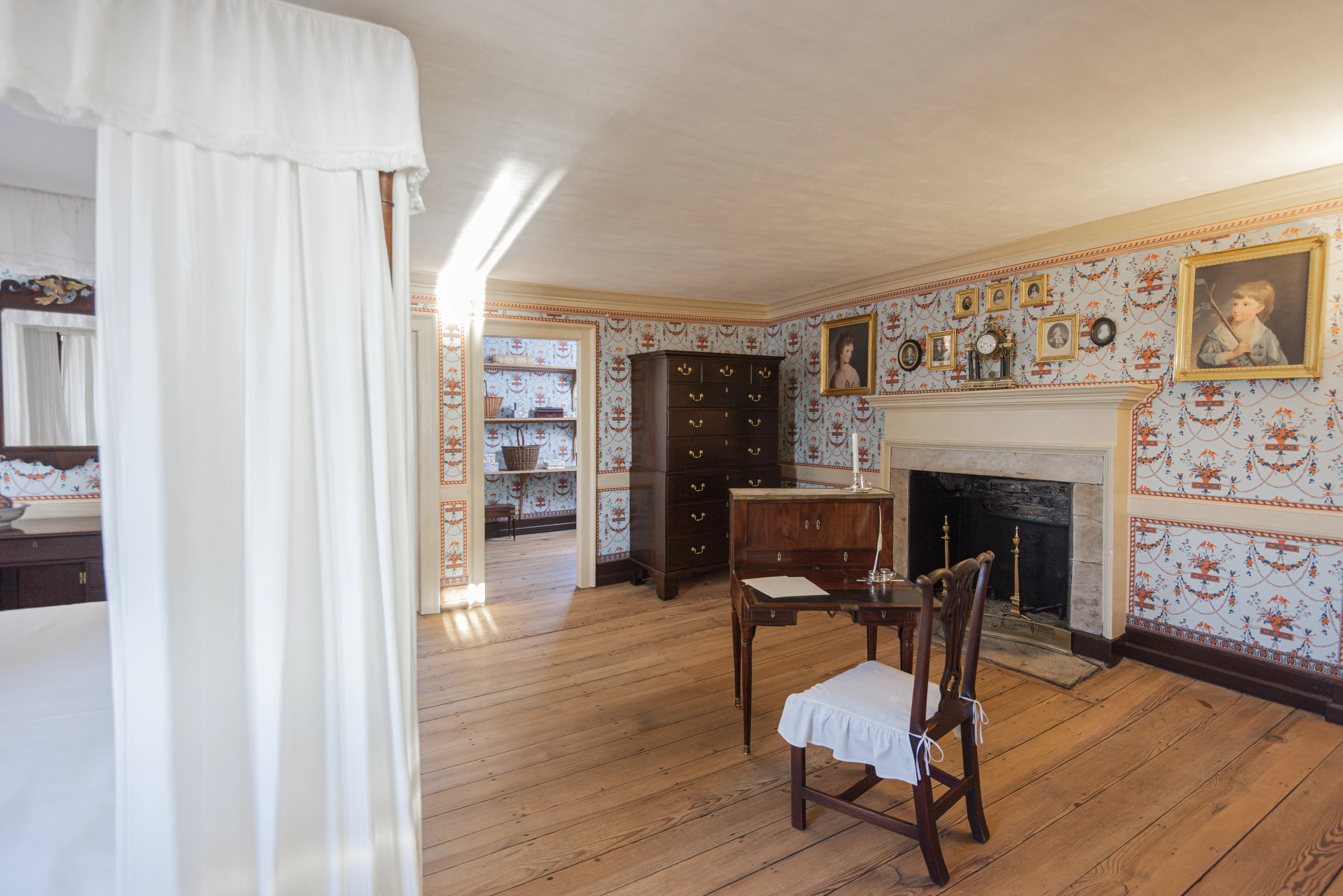
A combination of original, period, and reproduction furnishings represent the room’s appearance in 1799.
Furnishing the RoomA personal retreat, a busy workspace, and the room where George Washington died.
Here, Martha Washington shaped her daily routines, managed the household, supervised the work of enslaved servants, and carved out rare moments of quiet with her husband. It was also a room filled with memories: a place where her grandchildren played at her feet, where friends and family gathered for sewing and conversation, and where George Washington spent his final hours on December 14, 1799.
Today, after a major, research-driven restoration completed in 2025, visitors encounter the room as it would have appeared in 1799, during the Washingtons’ final years at Mount Vernon.
The Room's History
The Washingtons’ Bedchamber has a long and complex history that extends far beyond its association with Washington’s death. Constructed as part of the Mansion’s south wing addition of the mid-1770s, the room evolved over the decades into a center of family life, domestic management, and daily work. Closely connected to adjoining storage spaces and the back stairway, it formed a private suite where Martha Washington oversaw key aspects of the household.
Background
Construction of the south wing, which includes the Washingtons’ Bedchamber and the Study below, began in 1774 and was largely complete by the winter of 1775–1776. It would be many years, however, before the Washingtons could fully settle into their new bedchamber.
From 1775 until 1783, Martha Washington split her time between Mount Vernon and her husband’s headquarters each year. Packing up trunks for her trips to winter quarters, and unpacking upon her return, were likely some of the more momentous activities that occurred here during that timeframe. The space began to take on its more familiar character between 1783 and 1789, when George and Martha returned to Mount Vernon after the war. During this period, their two youngest grandchildren, Eleanor (Nelly) Parke Custis and George Washington (Washy) Parke Custis, came to live with them and spent countless hours in the room.
Significant changes occurred when the Washingtons prepared for retirement after the presidency. In 1796–1797, Washington requested measurements of many of the Mansion’s rooms, including the Washingtons’ Bedchamber, in order to determine how much wallpaper would be needed, and new wallpaper and furnishings were added throughout the home. Martha Washington commissioned a new bedstead in Philadelphia, and key objects acquired during the presidency, including a French mantel clock and a fine French writing desk, were installed in this room. Between 1797-1799, the Washingtons completed the furnishings of the room and enjoyed it as their personal retreat.
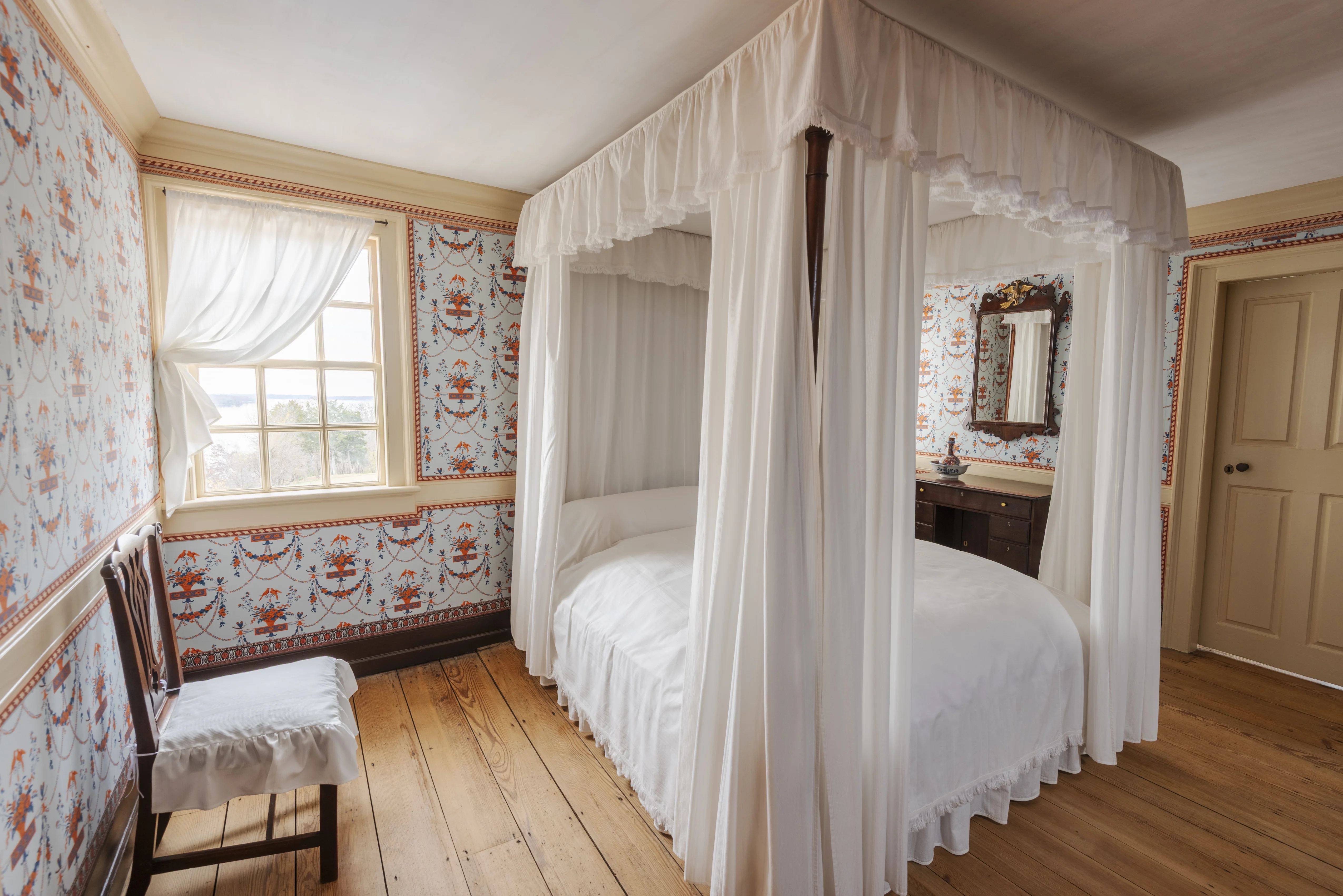
The Washingtons' Bedchamber, 2025. (George Brown / MVLA)
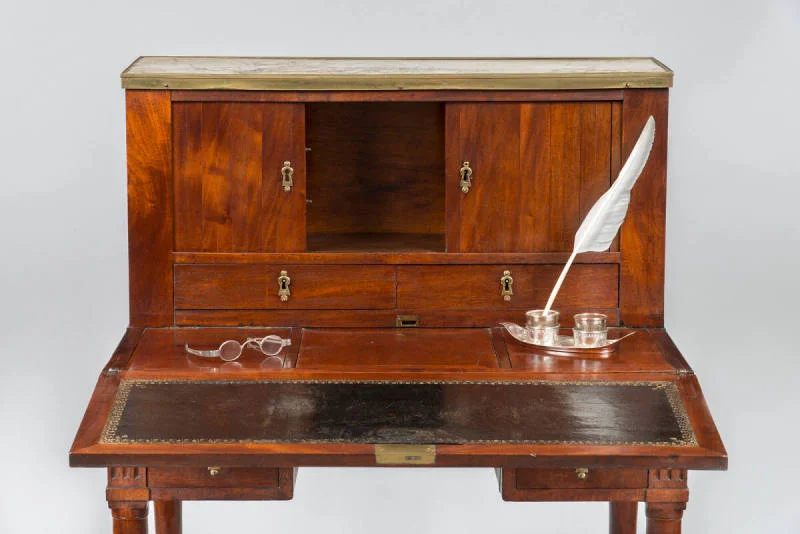
Martha Washington wrote and read countless letters at this diminutive, Louis XVI-style writing desk. Purchase, 1939. (MVLA)
Room Name
Although officially referred to today as the Washingtons’ Bedchamber, 18th-century writers regularly referred to the space as “Mrs. Washington’s.” This distinction reflects period customs within elite households, where the female head of household controlled the main family bedchamber, its furnishings, and access to it.
The room’s use and documentation reinforce this understanding. It was the site of Martha Washington’s morning prayers, her correspondence, and her management of the household. Here, she supervised clothing production, planned meals and domestic tasks with the hired white housekeeper, and stored valuables and personal work in adjoining spaces under her direct control.
While George Washington shared the bed and used the room each day, contemporaries understood it primarily as Martha Washington’s personal and authoritative domain, a status the modern name now acknowledges while still honoring the shared occupancy of the couple.
Although officially referred to today as the Washingtons’ Bedchamber, 18th-century writers regularly referred to the space as “Mrs. Washington’s.”
Adjoining Spaces
Two small rooms along the west side of the bedchamber formed an essential part of this private suite: Mrs. Washington’s closet (north) and Mrs. Washington’s store room (south). Architectural investigations during the 2025 restoration revealed original shelving, cubicles, and peg rails that confirmed their documented uses.
Mrs. Washington’s closet held her clothing, personal belongings, sewing projects, and valuables—particularly silver. Items such as baskets of sewing supplies, stored textiles, and personal purchases were kept within reach but under Martha Washington’s strict oversight.
Mrs. Washington’s store room contained household linens for use throughout the Mansion and outbuildings, blankets for enslaved workers, and the coarse linen and woolen cloth produced on the estate. Martha Washington or the housekeeper, Eleanor Forbes, supervised their distribution.
Adjacent to these spaces was the little passage, a narrow hallway that connected the bedchamber suite to the back stairway. Distinct from the Mansion’s main passage, it facilitated movement by hired and enslaved workers and allowed the Washington family a degree of privacy from the busy central hall.
Washington's Death
On December 14, 1799, George Washington died in the bedstead here. His secretary, Tobias Lear, described in detail the 36 hours leading up to the event, providing a tantalizing glimpse of how people moved in, out, and around the space amid the crisis.
Soon afterward, Mrs. Washington moved out of the room and, eventually, established her bedchamber on the third floor. One visitor recorded that, “She has not entered either his study or the apartment in which he died since the removal of his corpse.”1 From then until her own death in 1802, the room was maintained and used only by the enslaved and hired workers and family members who needed to move or retrieve objects.
1. Eliza Cope Harrison, ed. Philadelphia Merchant: The Diary of Thomas P. Cope 1800-1851 (South Bend, Indiana: Gateway Editions, 1978), 112.

The death of George Washington, ink on paper, c. 1886-1887, Print-5044/RP-774. (MVLA)
2025 Restoration
In 2025, Mount Vernon’s Historic Preservation & Collections Department completely restored and refurnished the Washingtons’ Bedchamber and the adjoining spaces following in-depth physical investigation of the architectural features, paint analysis of the woodwork, careful study of the Washingtons’ papers, reevaluation of the probate inventory descriptions, and extensive architectural and material culture research.
Architectural Elements
The 2025 restoration offered an unprecedented opportunity to study and conserve the wooden elements of the Mansion’s south wing, many of which survive from the mid-1770s.
A central focus of the project was the complete re-plastering of the walls and ceilings—in the Washingtons’ Bedchamber, Mrs. Washington’s closet and store room, the little passage, and the back stairway—for the first time since 1949. Preservation staff removed the modern plaster and metal lath, executed wood repairs, and applied a traditional three-coat lime plaster mixed with animal hair—just as would have been used in the 18th century.
With the walls open, the team was able to examine the original structure in remarkable detail. Dendrochronology confirmed that the framing timbers were felled in the spring and summer of 1774, and most of the 18th-century wooden lath (the thin, wooden strips nailed to the framing, onto which plaster is applied) was still intact.
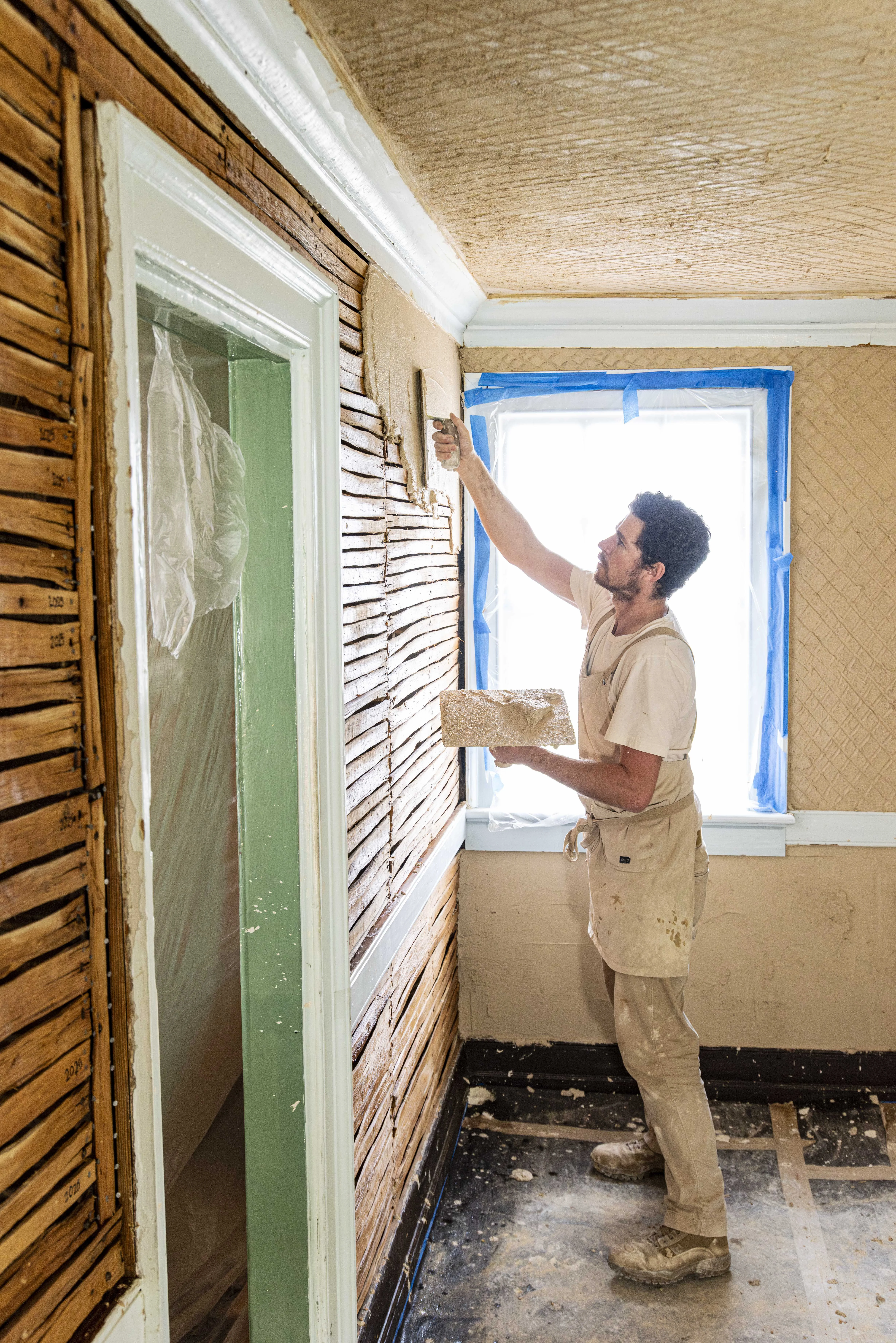
Plasterer Henry Orton applies the first or "scratch" coat of new plaster to the Washingtons' Bedchamber walls. (MVLA)
Discoveries
With the 1949 plaster removed, several important discoveries came to light:
Evidence of a small 18th-century fire was found at the juncture of the north wall and ceiling, just above the mantel.
Fragments of early plaster and a piece of 19th-century moiré wallpaper were uncovered on the ceiling and preserved in Mount Vernon’s collections.
Original shelving configurations in Mrs. Washington’s closet and store room were confirmed through physical evidence.
A fully intact 18th-century fork was discovered inside a wall cavity in Mrs. Washington’s closet, supporting its historic use as secure storage for silver and valuables.
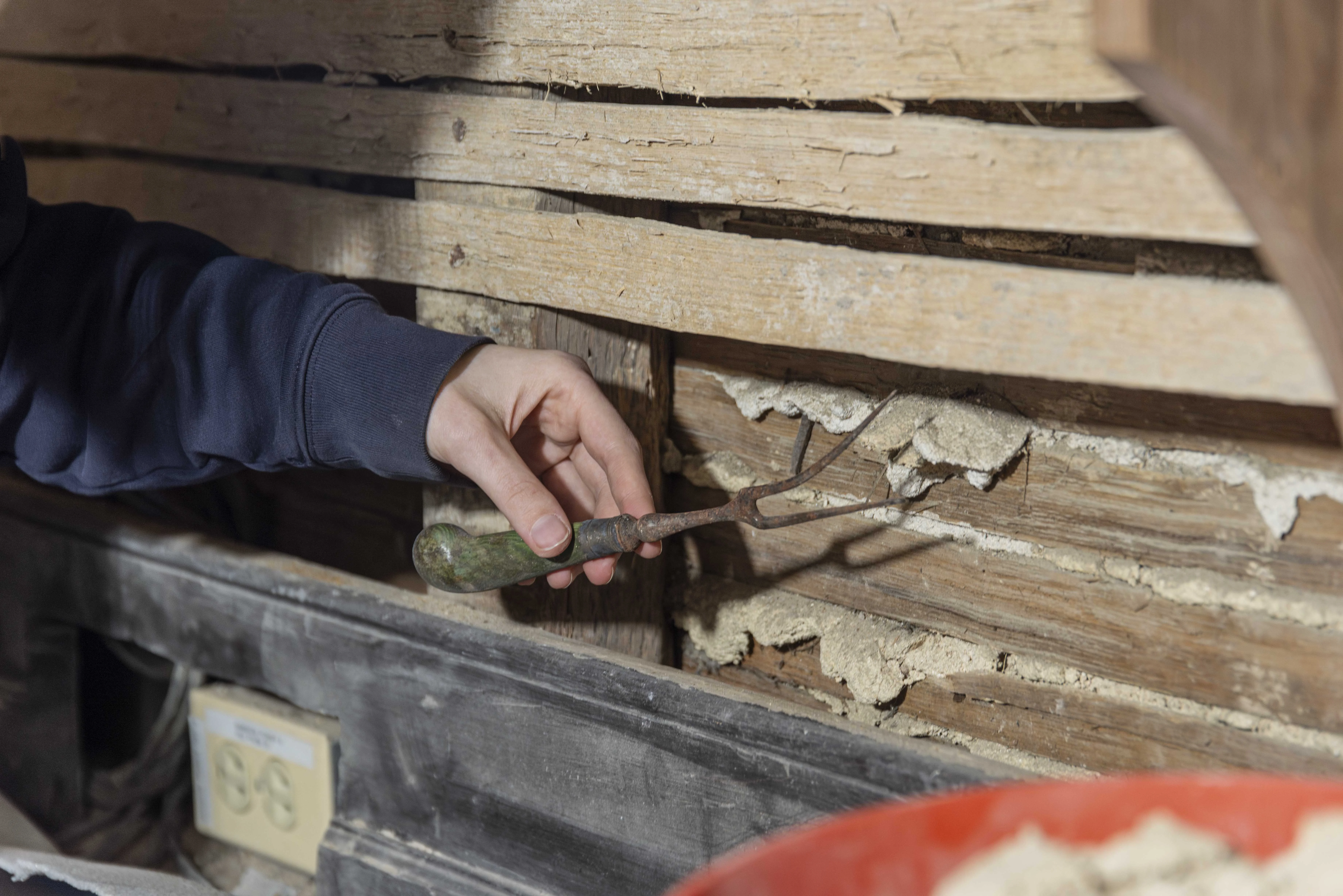
During the restoration of the Washingtons' Bedchamber, an 18th-century fork belonging to the Washingtons was discovered behind the wall of Martha Washington's closet. Here, the fork is photographed in the place in which it was discovered. (George Brown / MVLA)
Wallpaper and Paint
After the new plaster cured, the Preservation team restored the room’s finishes using hand-ground linseed oil paint and traditionally installed, hand-block-printed wallpaper and borders.
Paint analysis of the woodwork identified several generations of paint from the 1775–1799 period, revealing far more detail about the wall finish history than previous analyses. When the south wing was first constructed, the woodwork throughout the wing was painted gray. By the late-1790s, however, when updates were being made throughout the Mansion, the paint on the principal woodwork in the Washingtons’ Bedchamber and the surrounding spaces had changed to varying shades of cream, with the mopboards painted dark brown. As we have seen throughout the Mansion, the change to a neutral color was indicative of the Washingtons’ desire to stay fashionable.
The addition of wallpaper went hand-in-hand with the updating of paint colors. Documentary evidence suggests that, in 1797, as part of the larger renovations throughout the house, the Washingtons added or updated wallpaper in the room and the surrounding spaces.
The original plaster and wall finishes from George and Martha Washington’s lifetime were removed in the 19th century. In order to correctly represent the 1790s aesthetic of the Washingtons’ Bedchamber, the curators looked for a period paper that could be dated to the mid-1790s, that was from a French, English, or American source, and that was documented as having been used in the United States. A historic paper originally installed in the Emerson Homestead in York, Maine, c. 1794–1795, fulfilled all of these criteria and was a documented pattern made by Réveillon, Jacquemart et Bénard, the preeminent French wallpaper firm which also made the borders used by the Washingtons in the New Room. The arabesque pattern, inspired by the classical Roman frescoes found at sites such as Pompeii and Herculaneum, features a pair of love birds, a common romantic motif appropriate for a bedchamber.
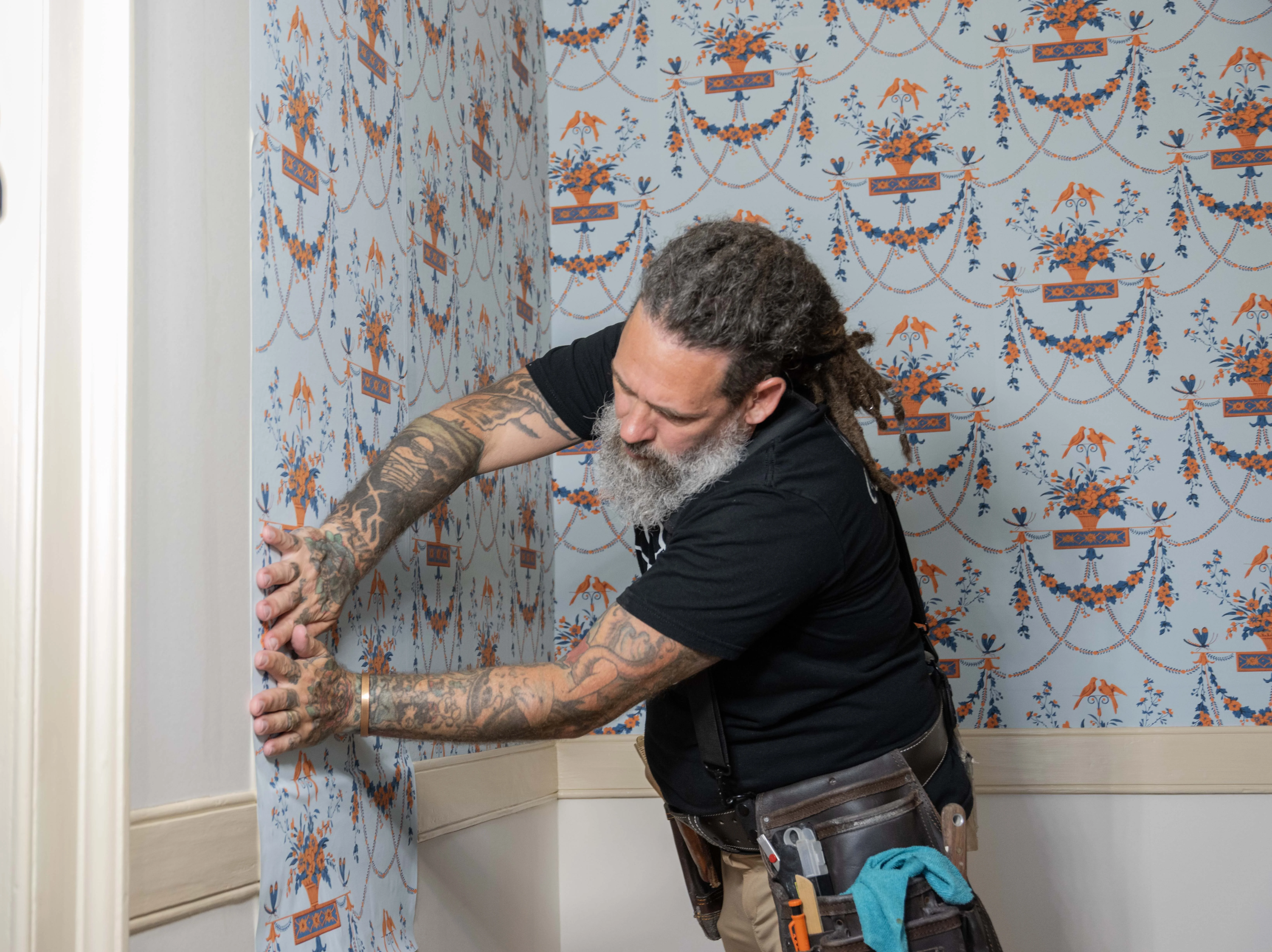
Hand-block-printed wallpaper is installed in the Washingtons' Bedchamber. (George Brown / MVLA)
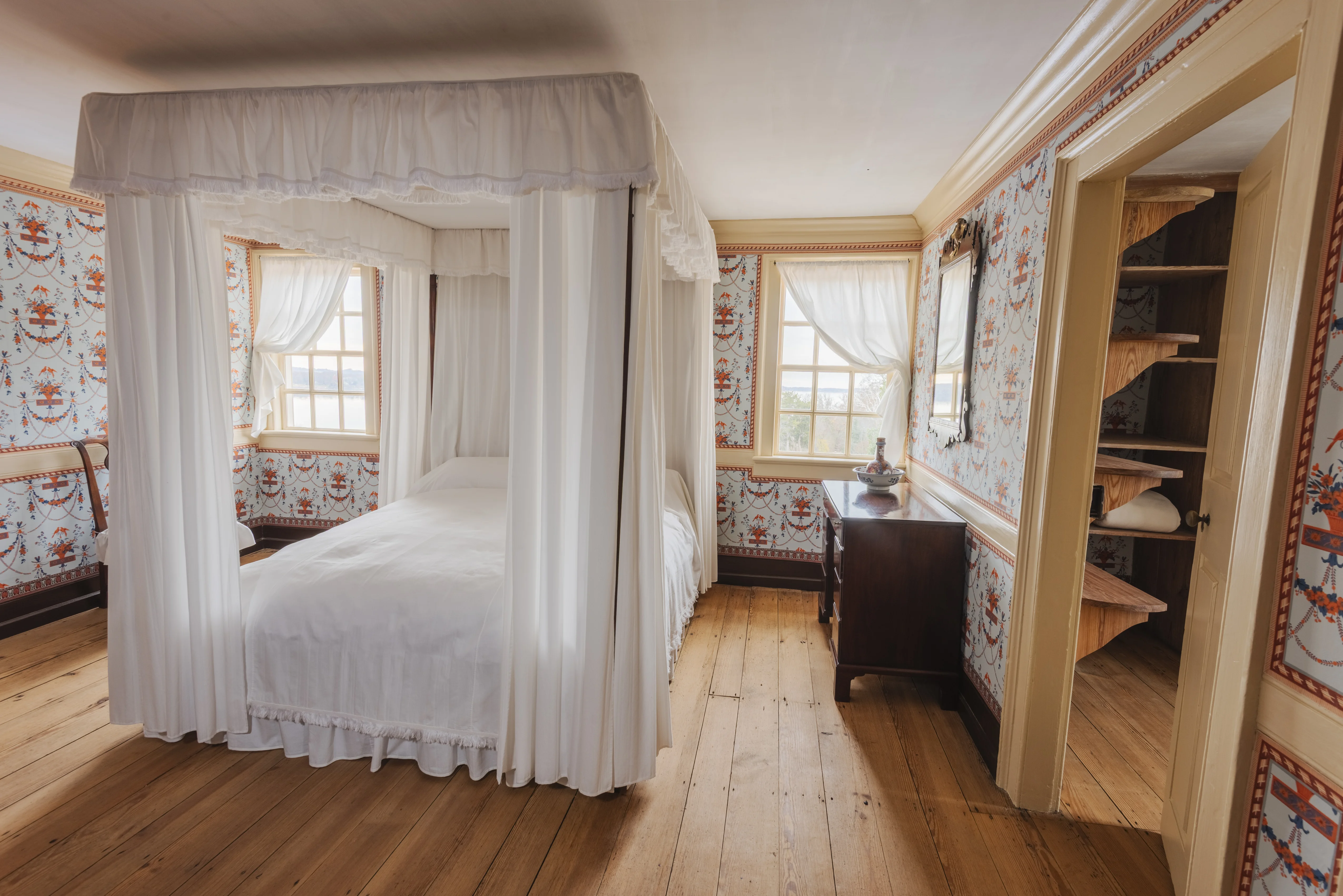
The Washingtons' Bedchamber, 2025. (George Brown / MVLA)
For the little passage and back stairway, the curatorial team commissioned a reproduction of a historic paper used in a similar context: the back hall of the Harrison Gray Otis house in Boston, installed c. 1796. Harrison Gray Otis and his wife, Sarah Foster Otis, were leading members of Boston society, strong Federalists, and of a comparable social station with the Washingtons.
For the service areas of the house, the Otises’ chose less-expensive, American-made papers. The paper features a striped pattern with alternating columns of flowers, identified by Mount Vernon’s horticultural team as wisteria and bouquets of lilacs and purple coneflower (a flower native to the northeastern United States).
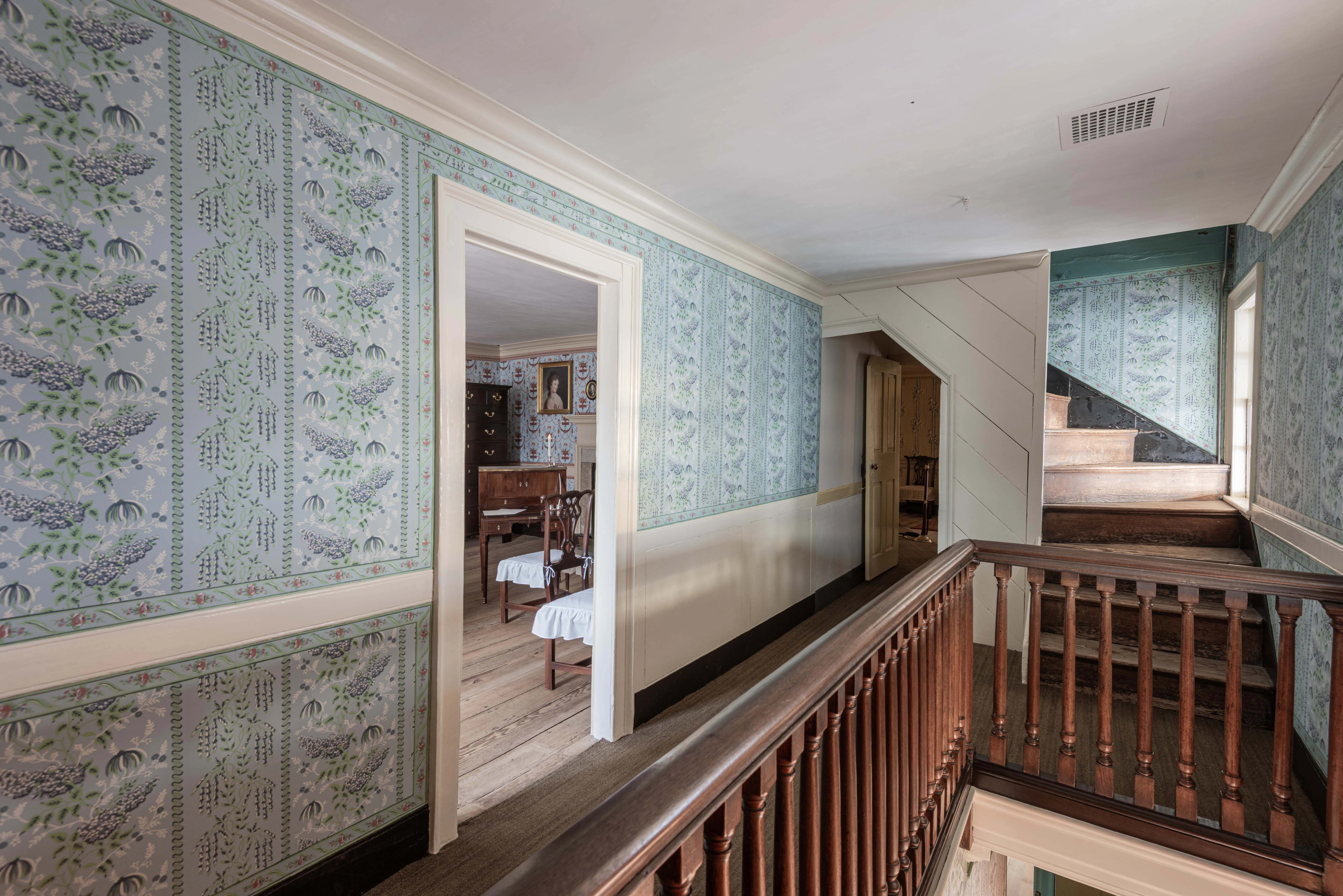
The little passage adjoining the Washingtons' Bedchamber, 2025. (George Brown / MVLA)
Arrangement of the Room
The Washingtons’ Bedchamber is the only space in the Mansion with specific visual evidence for its 18th-century layout, thanks to an 1835 painting by John Gadsby Chapman. Working with the Custis grandchildren, Chapman documented the room’s original arrangement and several of its authentic furnishings, including the Washingtons’ bedstead, chest on chest, writing desk, and dressing table, all of which survive today. Other details of the painting were speculative, and Chapman filled in the chairs, dressing glass, stand, carpet, and fishbowl to complete the scene.
Curators used this painting, along with documentary sources, to guide the placement of the room’s principal pieces. While the chairs and smaller objects would have shifted in daily use—for example, the writing desk might have been moved closer to the windows for light or nearer the fire for warmth—Chapman’s carefully composed view provides the clearest record of how the room appeared when “at rest.”
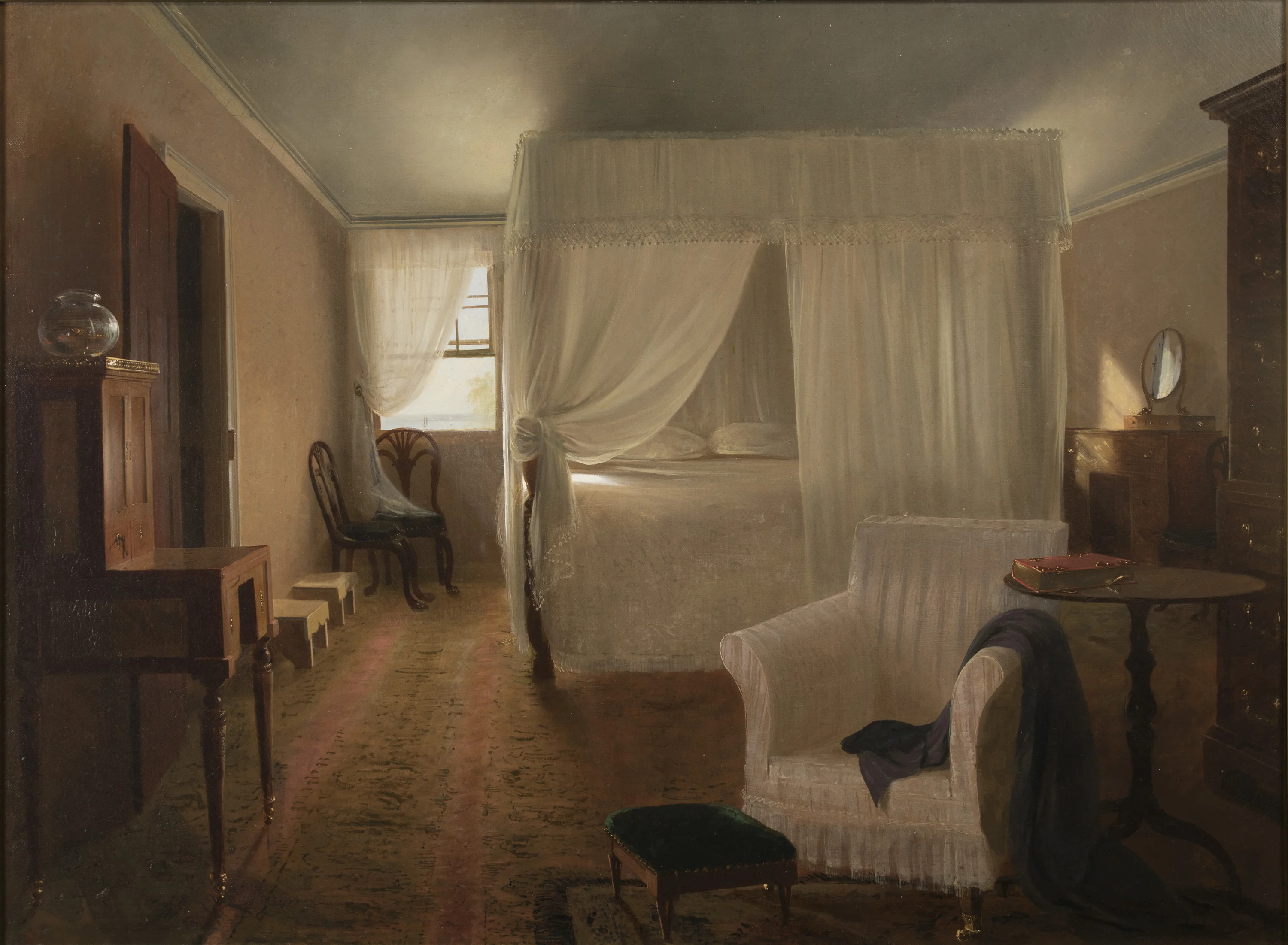
Mount Vernon curators used John Gadsby Chapman's 1835 painting, along with documentary sources, to guide the placement of the room’s principal pieces. Acquired through the generosity of Lucy S. Rhame and an anonymous donor, 2017 Conservation courtesy of The Founders, Washington Committee Endowment Fund. (MVLA)
Furnishings
The Bedstead
The original mahogany bedstead is the centerpiece of the room and one of its most significant artifacts. Martha Washington called it the “new bedstead which I caused to be made in Philadelphia,” a custom commission from the 1790s distinguished by its elegant turned posts and unusually wide frame—a full six feet, broader than the average bedsteads of the period. The reproduction dimity bed curtains, together with dimity window curtains and slipcovers, reflect the Washingtons’ preference for coordinating textiles throughout the room.

This generously sized bedstead's tall, slender, turned posts, devoid of any carving, exemplify the elegant, neat and plain style the Washingtons favored. Gift of George Washington Custis Lee, 1908. (MVLA)
Video: Restoring the Washingtons' Bedchamber
Take an in-depth tour of the Washingtons' Bedchamber during its 2025 restoration.
Writing Desk and Clock
The original French bonheur du jour, or writing desk (pictured above), was acquired in 1790 from the household of the French minister, the Comte de Moustier. Martha Washington used it for her correspondence, and it was inside this desk that two of George Washington’s surviving letters to his wife were later discovered. Fully finished on all sides, the desk was designed to be movable, so that it could be used wherever it was most convenient in a room, whether near the window or near the fireplace; an original silverplate inkstand rests atop it.
On the mantel stands the original French mantel clock, made in 1788 and valued at $100 on the probate inventory—the most expensive single furnishing in the room. Martha Washington first used it in the presidential household before bringing it to Mount Vernon.
Dressing Table and Personal Items
One of the oldest furnishings in the room is Martha Washington’s original mahogany bureau dressing table, made in 1754 by Williamsburg cabinetmaker Peter Scott. The “neat and plain” mahogany bureau was designed with lower drawers that lacked handles and could only be accessed with keys, signaling its role in securing Martha’s valuables.
An original Chinese export guglet and basin, used for daily washing, also stands on the table, accompanied by a period looking glass on the wall above.
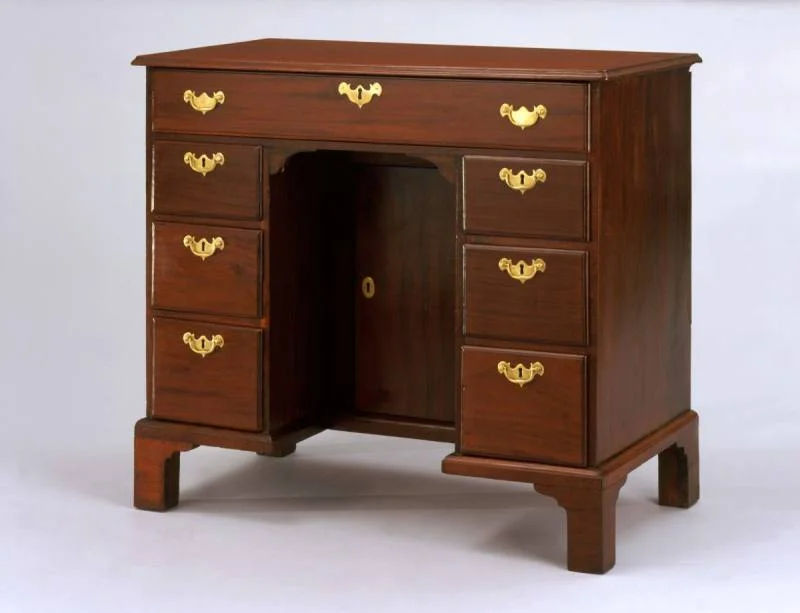
One of the oldest furnishings in the room is Martha Washington’s original mahogany bureau dressing table, made in 1754 by Williamsburg cabinetmaker Peter Scott. Purchase, 1939. (MVLA)
Fireplace Furnishings
At the hearth, reproduction brass urn-topped andirons represent the original pair, now in the collection of Tudor Place, and a period brass fender reflects the type that would have been used in the room. Inside the fireplace, the original cast iron fireback, commissioned by George Washington in 1787 from Batsto Furnace, remains in place and features his crest and “GW” cypher.
Storage Furniture
Near the closet is a reproduction chest on chest, modeled on the original now in the Tudor Place collection, made by the shop of William Gomm in London in 1763. With 10 lockable drawers, this substantial piece stored Martha Washington’s extensive wardrobe, from shifts and petticoats to aprons, caps, shawls, and accessories. The Washingtons acquired the original at the 1774 Belvoir estate sale.
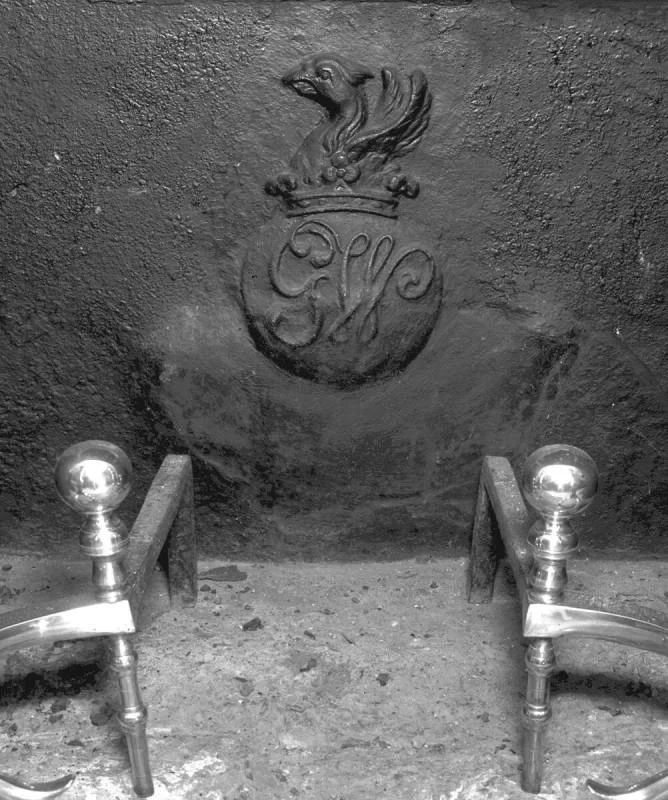
Firebacks served the practical (and valuable) purpose of protecting the bricks lining a fireplace from heat damage. This original cast iron fireback was commissioned by George Washington in 1787 from Batsto Furnace. Transferred to the Mount Vernon Ladies' Association through the generosity of John Augustine Washington III, 1860. (MVLA)
Current Restoration Projects
The restoration of Mount Vernon is an ongoing process that began in the 19th century and continues today.
See Ongoing Projects