George Washington shared the Declaration of Independence with the Continental Army in New York on July 9, 1776. He received the news directly from John Hancock, the president of the Continental Congress. Hancock and Washington were in near-daily correspondence as the Continental Congress worked to support the Continental Army ahead of an anticipated British attack on New York and challenging circumstances for the army in Canada. However, Hancock had not made any mention of the debates about independence happening in Philadelphia. Instead, across the colonies, newspapers helped to spread the news that the Congress had postponed the debate until Monday, July 1. By the early days of July, Washington and his officers in New York knew that a decision about independence would be coming soon.
Washington learned of the events in Philadelphia through a letter he received from Hancock written on July 6. Hancock informed him of the historic signing of the Declaration of Independence. In his letter, he explained that “The Congress, for some Time past, have had their Attention occupied by one of the most interesting and important Subjects, that could possibly come before them, or any other Assembly of Men.” He admitted that “it is not possible to foresee the Consequences of Human Actions,” but the Congress felt that it was their “Duty” to themselves and to posterity to make the best decision for the colonies. They were also “fully convinced” that the fight with Great Britain would “take a more favourable Turn.”1
By order of the Congress, Hancock directed Washington to have the Declaration of Independence “proclaimed at the Head of the Army” in whatever manner Washington thought “most proper.”2 It seems likely that Hancock enclosed a number of broadsides, or poster-sized sheets with the Declaration printed on one side, created by John Dunlap. Dunlap began printing the Declaration in Philadelphia on the night of July 4 and into the day of July 5. Two Dunlap broadsides have been located in Washington’s papers: one at the Library of Congress, which is lacking the bottom part of the document, and one at the University of Virginia.3 Many more printed copies would have been needed to be read aloud to the soldiers fighting for independence.
In the General Orders for July 9, Washington explained that the Congress, “impelled by the dictates of duty, policy and necessity” had “been pleased to dissolve the Connection” between the colonies and Great Britain. He ordered the brigades in New York to assemble at six o’clock that evening, “when the declaration of Congress, shewing the grounds & reasons of this measure, is to be read with an audible voice.”4 One voice alone would not be able to carry over such a large crowd; instead, someone stepped to the front of each brigade and read the Declaration aloud, likely from one of John Dunlap’s broadsides.
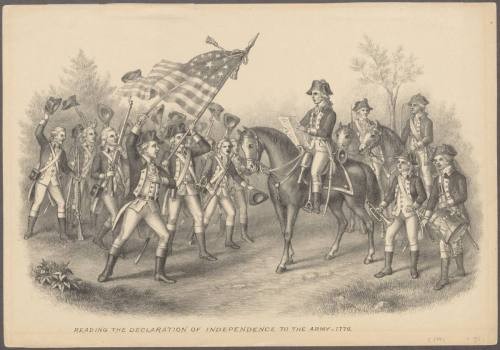
Different soldiers recorded this experience in their personal records of the war. Connecticut-born Samuel Blachley Webb, one of Washington’s aides-de-camp, wrote in his journal that, “Agreeable to this day’s orders, the Declaration of Independence was read at the Head of each Brigade; and was received by three Huzzas from the Troops.” He sensed that his fellow soldiers were “highly pleased” by the Congress’s decision to separate from Great Britain. Caleb Clapp, a young ensign from Massachusetts, wrote in his diary that “this day the Declaration of the Independant States of America was read at the Head of the Brigade,” after which the soldiers sang a psalm, their chaplain offered a prayer, and “the whole” gave “three Cheers.”5 Tragically, the chaplain, Reverend Abiel Leonard, later took his own life. His experience shows how the joyful news of July 9 only lasted a short time, and difficult days were ahead for the Continental Army.
Washington hoped that hearing the Declaration of Independence read aloud would “serve as a fresh incentive to every officer, and soldier, to act with Fidelity and Courage, as knowing that now the peace and safety of his Country depends (under God) solely on the success of our arms.”6 The Congress’s decision put the pressure on the Continental Army to win the war and secure independence from Great Britain—an effort which would take years of fighting, losses, and strategic alliances.
Emily Sneff, PhD
Notes:
1. John Hancock to George Washington, July 6, 1776, in The Papers of George Washington, Revolutionary War Series, Vol. 5, 16 June 1776–12 August 1776, ed. Philander D. Chase (Charlottesville: University Press of Virginia, 1993): 219–21.
2. For more on this episode and other instances of the Declaration of Independence being communicated to the Continental Army, see Emily Sneff, When the Declaration of Independence Was News (New York: Oxford University Press, 2026).
3. John Dunlap, Broadside of the Declaration of Independence, July 4–5, 1776, Washington Papers, Manuscript Division, Library of Congress; John Dunlap, Broadside of the Declaration of Independence, July 4–5, 1776, Albert H. Small Declaration of Independence Collection, University of Virginia. The University of Virginia copy was once owned by Washington’s longtime secretary, Tobias Lear.
4. General Orders, July 9, 1776, in The Papers of George Washington, Revolutionary War Series, 5:245–47.
5.“Diary of Ensign Caleb Clap, of Colonel Baldwin’s Regiment, Massachusetts Line, Continental Army, March 29 Until October 23, 1776,” The Historical Magazine, 3rd ser., vol. 3, no. 3 (March 1874): 137–38.
6. General Orders, July 9, 1776, in The Papers of George Washington, Revolutionary War Series, 5:245–47.
Bibliography:
Armitage, David. The Declaration of Independence: A Global History. Harvard University Press, 2009.
Maier, Pauline. American Scripture: Making the Declaration of Independence. Knopf Doubleday Publishing Group, 1997.
Sneff, Emily. When the Declaration of Independence Was News. Oxford University Press, 2026.