
Reassessing Jefferson's Approach to Slavery
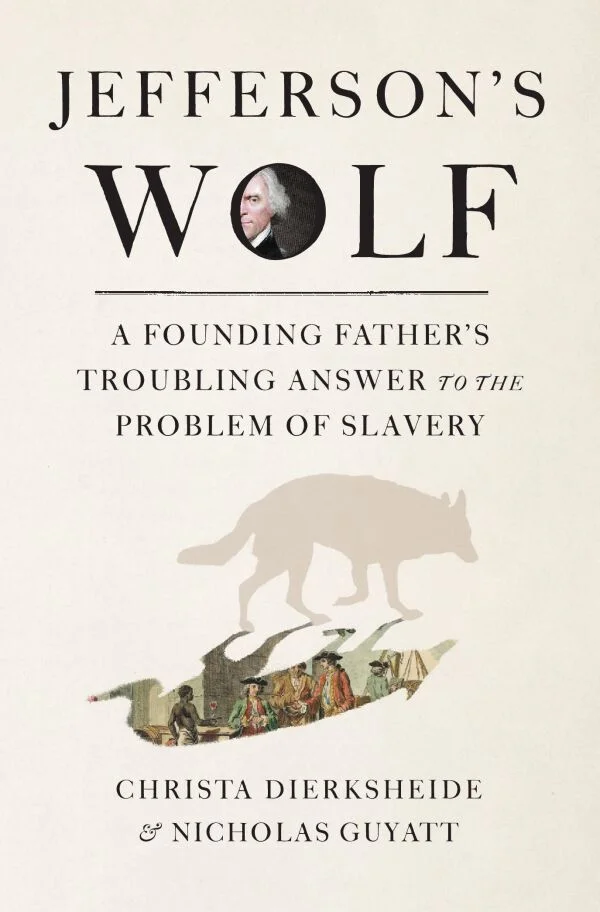
Explore the decisive reassessment of Thomas Jefferson’s long-debated views on slavery, showing that his chief antislavery strategy was racial exclusion: the removal of emancipated Black people from the United States.
Toward the end of his life, Thomas Jefferson made his most famous statement about American slavery: “We have the wolf by the ear, and we can neither hold him, nor safely let him go.”
Presenting abolition as both necessary and perilous, the remark has long been relied upon to explain an apparent paradox: despite publicly opposing slavery for four decades, Jefferson had made no progress toward Black freedom in his political career by the time he died in 1826. Nor had he done so in his expansive household, where he enslaved more than 600 people, including Sally Hemings and the four children he fathered with her.
Christa Dierksheide and Nicholas Guyatt argue that the key to understanding Jefferson’s antislavery position is his commitment to racial exclusion. Jefferson believed that the principal reason to abolish slavery was the threat of a massive slave revolt, but he viewed the presence of free Black people in the new nation as no less dangerous. To avert racial violence, Jefferson argued, the gradual abolition of slavery had to be paired with Black exile. Even when challenged by white and Black contemporaries with more expansive views of American belonging, Jefferson held fast to his vision for a white republic.
Neither an egalitarian antiracist nor a proslavery apologist, Jefferson became the most influential advocate for racial separation in the early United States. Charting the evolution of his thought across the nation’s formative decades, Jefferson’s Wolf is a surprising and provocative account of the problem of slavery in the founding era.
About the Authors

Christa Dierksheide
Christa Dierksheide is Brockman Foundation Jefferson Scholars Foundation Professor of History at the University of Virginia. Her first book, Amelioration and Empire: Progress and Slavery in the Plantation Americas, 1770-1840 brought the Anglophone Caribbean and the U.S. South into the same frame, arguing that “improvement” lay at the core of both proslavery and antislavery thinking.
Her second book, Beyond Jefferson: the Hemingses, Randolphs, and the Making of Nineteenth Century America, is a global history of Jefferson’s grandchildren on both sides of the color line. Her third book, Jefferson's Wolf: The Struggle to End Slavery in the Founding Era, co-authored with Nick Guyatt, was published in 2026.
Before returning to academia, she worked as the historian at the Robert H. Smith International Center for Jefferson Studies at Monticello, where she curated or contributed to several exhibitions, including: The Boisterous Sea of Liberty, in 2008; Mulberry Row: Landscape of Slavery, in 2012; and Sally Hemings: A Life in 2018. She co-teaches Race and Slavery on UVA's North Grounds.

Nicholas Guyatt
Nicholas Guyatt did his BA and M.Phil. at Cambridge, and completed his Ph.D. at Princeton under the supervision of Daniel T. Rodgers. Having taught at Princeton, Simon Fraser University in Vancouver, and the University of York, Guyatt joined the History Faculty at Cambridge in 2014.
He has been a faculty fellow at the Stanford Humanities Center (2009-10), a British Academy Mid-Career Fellow (2013-14), and the Senior Visiting Research Fellow at the Rothermere American Institute in the University of Oxford (2013-14).
Guyatt writes about American history and politics. His work has appeared in the New York Review of Books, the London Review of Books, the New York Times, the Nation magazine, the Times Literary Supplement, the Guardian, the Telegraph, the i Paper, and many other publications.