
The George Washington Prize is one of the nation’s largest and most prestigious literary awards.
The George Washington Prize honors outstanding new works on George Washington and his times (the Revolutionary and founding eras circa 1760-1820).
The $50,000 prize is sponsored by Washington College, the Gilder Lehrman Institute of American History, and George Washington’s Mount Vernon.
George Washington Prize 2025 Recipient
Serpent in Eden: Foreign Meddling and Partisan Politics in James Madison's America
by Tyson Reeder
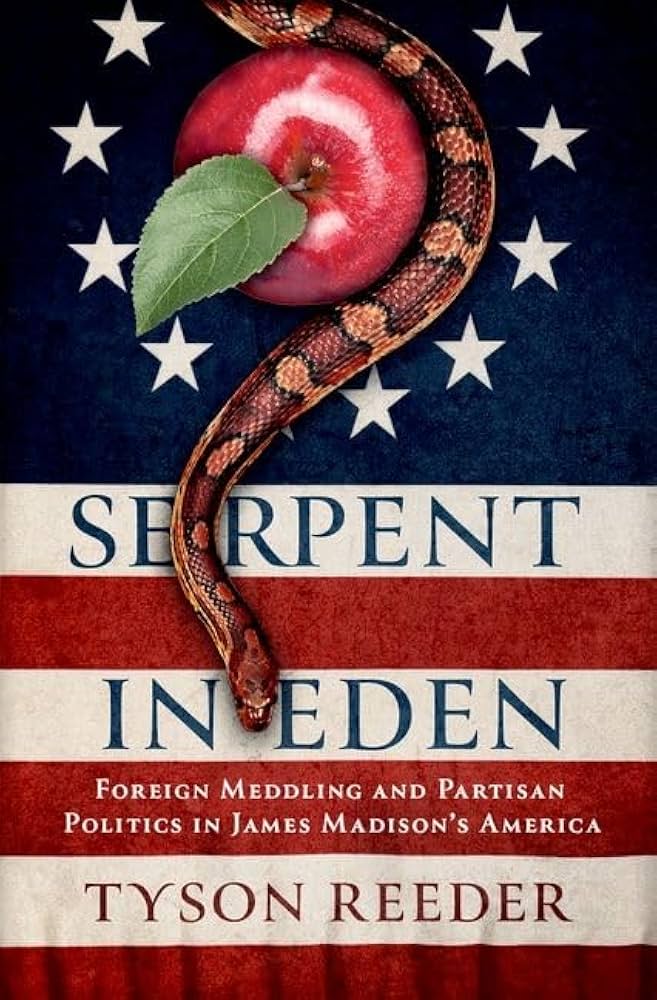
Tyson Reeder's book traces early America's rocky beginnings, when foreign interference and political conflict threatened to undermine its aspirations and ideals, even its very existence. Spanning the period from the Revolution to the War of 1812, and focusing particularly on the presidency of James Madison, it reveals a nation adjusting to rancorous partisan politics, aggravated by the untested and imperfect new tools of governance and the growing power of media. Foreign powers, mainly Great Britain and Napoleonic France, exploited these conditions to advance their own agendas, interfering in U.S. elections to promote the outcome they favored. Dissent and disloyalty became dangerously interdigitated, nearly bringing the new republic to the brink of collapse.
No figure was more in the center of it all than James Madison. As a leading delegate at the Constitutional Convention, Republican congressional leader, secretary of state, and president, Madison grappled with foreign meddling for over three decades. At the same time, he emerged as a political leader, feeding the very partisanship that bred foreign intrigues. As chief executive, he presided over the calamitous barrage of accusations and counteraccusations of foreign collusion that culminated in the War of 1812. Madison left a mixed but indelible legacy: as a fierce adversary of foreign interference, a fiery champion of political debate, and a partisan operative who facilitated the former by inflaming the latter.
Forged in partisan conflict, the United States remains vulnerable to forces that test whether the constitutional system Madison was so central in implementing can withstand outside meddling while accommodating partisan conflict. Madison's successes and failures, along with his original vision of the Constitution and party politics, illuminate the ongoing struggle between domestic polarization and foreign interference.
2025 Finalists
Speculation Nation: Land Mania in the Revolutionary American Republic
By: Michael A. Blaakman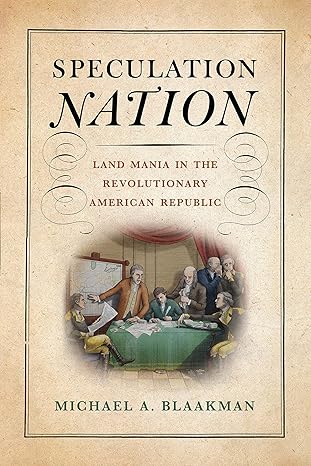
During the first quarter-century after its founding, the United States was swept by a wave of land speculation so unprecedented in intensity and scale that contemporaries and historians alike have dubbed it a “mania.” In Speculation Nation, Michael A. Blaakman uncovers the revolutionary origins of this real-estate bonanza―a story of ambition, corruption, capitalism, and statecraft that stretched across millions of acres from Maine to the Mississippi and Georgia to the Great Lakes.
Patriot leaders staked the success of their revolution on the seizure and public sale of Native American territory. Initially, they hoped that fledgling state and national governments could pay the hefty costs of the War for Independence and extend a republican society of propertied citizens by selling expropriated land directly to white farmers. But those democratic plans quickly ran aground of a series of obstacles, including an economic depression and the ability of many Native nations to repel U.S. invasion. Wily merchants, lawyers, planters, and financiers rushed into the breach. Scrambling to profit off future expansion, they lobbied governments to convey massive tracts for pennies an acre, hounded revolutionary veterans to sell their land bounties for a pittance, and marketed the rustic ideal of a yeoman’s republic―the early American dream―while waiting for land values to rise.
When the land business crashed in the late 1790s, scores of “land mad” speculators found themselves imprisoned for debt or declaring bankruptcy. But through their visionary schemes and corrupt machinations, U.S. speculators and statesmen had spawned a distinctive and enduring form of settler colonialism: a financialized frontier, which transformed vast swaths of contested land into abstract commodities. Speculation Nation reveals how the era of land mania made Native dispossession a founding premise of the American Republic and ultimately rooted the United States’ “empire of liberty” in speculative capitalism.
The Rediscovery of America: Native Peoples and the Unmaking of U.S. History
By: Ned Blackhawk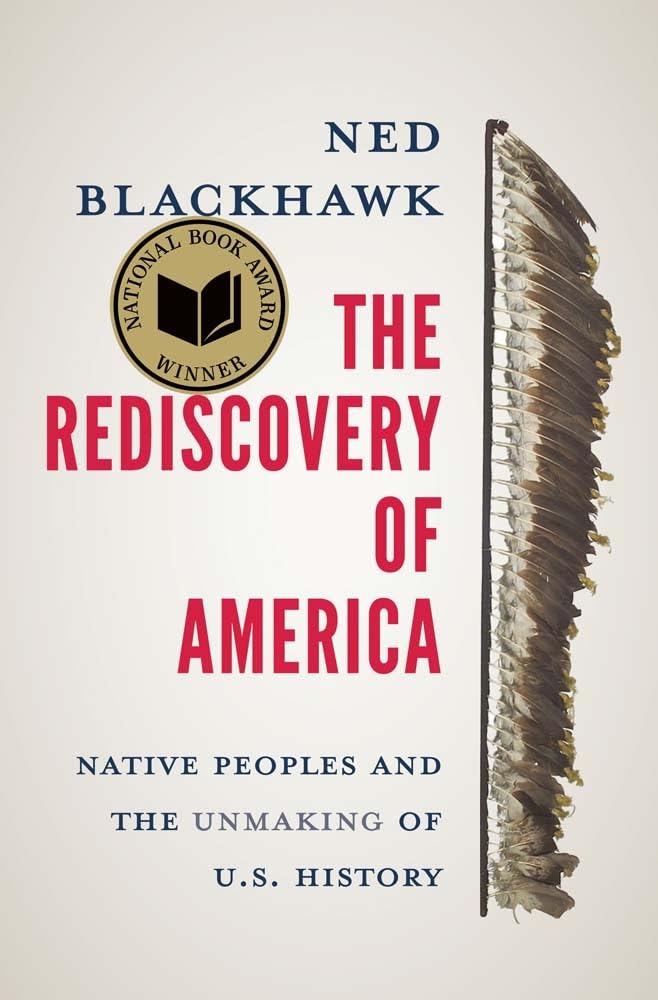
The most enduring feature of U.S. history is the presence of Native Americans, yet most histories focus on Europeans and their descendants. This long practice of ignoring Indigenous history is changing, however, as a new generation of scholars insists that any full American history address the struggle, survival, and resurgence of American Indian nations. Indigenous history is essential to understanding the evolution of modern America.
Ned Blackhawk interweaves five centuries of Native and non‑Native histories, from Spanish colonial exploration to the rise of Native American self-determination in the late twentieth century. In this transformative synthesis, he shows that
• European colonization in the 1600s was never a predetermined success;
• Native nations helped shape England’s crisis of empire;
• The first shots of the American Revolution were prompted by Indian affairs in the interior;
• California Indians targeted by federally funded militias were among the first casualties of the Civil War;
• the Union victory forever recalibrated Native communities across the West;
• twentieth-century reservation activists refashioned American law and policy.
Blackhawk’s retelling of U.S. history acknowledges the enduring power, agency, and survival of Indigenous peoples, yielding a truer account of the United States and revealing anew the varied meanings of America.
First Family: George Washington's Heirs and the Making of America
By: Cassandra A. Good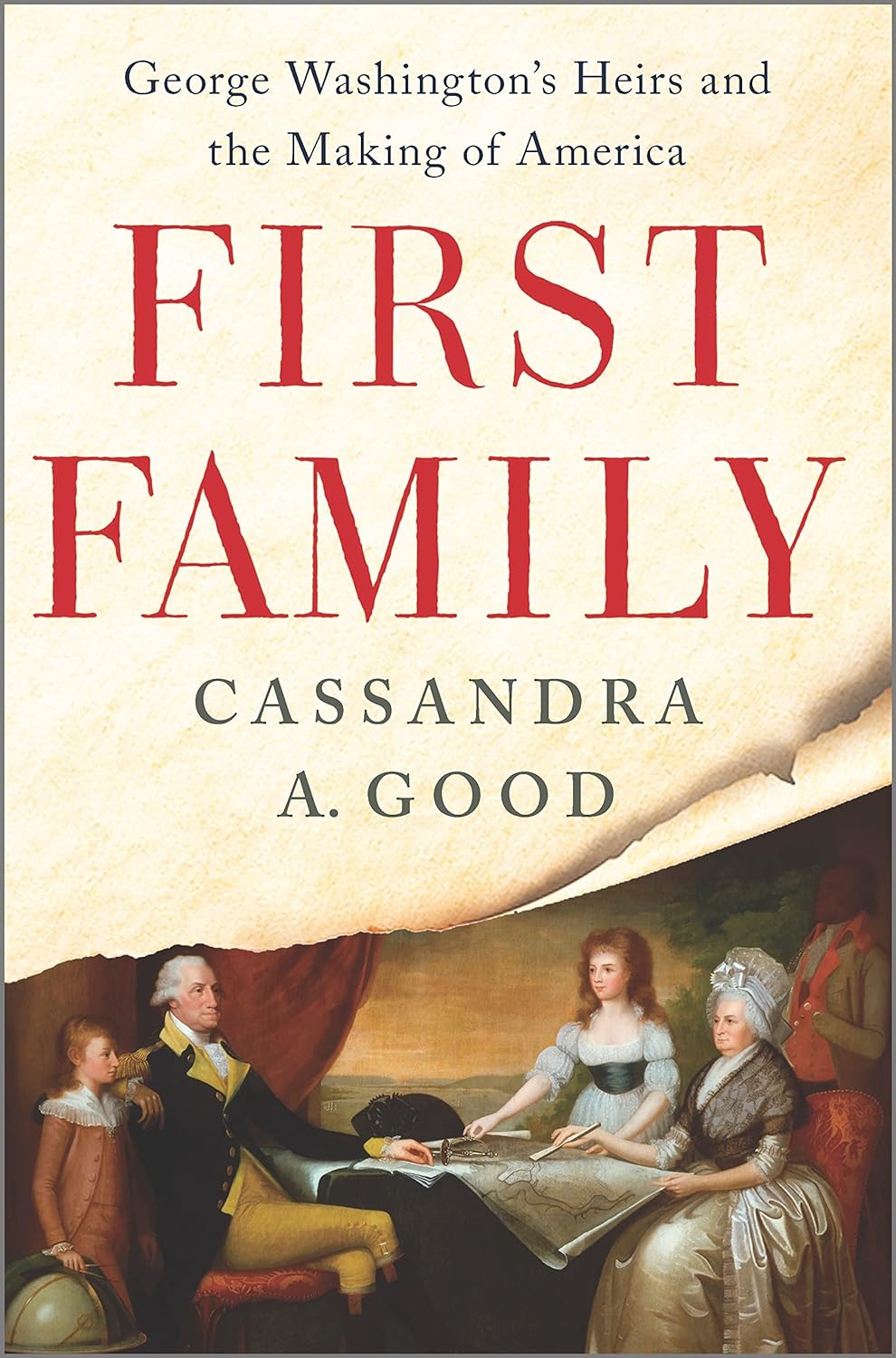
While it’s widely known that George and Martha Washington never had children of their own, few are aware that they raised children together. In First Family, we see Washington as a father figure and are introduced to the children he helped raise, tracing their complicated roles in American history.
The children of Martha Washington’s son by her first marriage—Eliza, Patty, Nelly, and Wash Custis—were born into life in the public eye, well-known as George Washington’s family and keepers of his legacy. By turns petty and powerful, glamorous and cruel, the Custises used Washington as a means to enhance their own power and status. As enslavers committed to the American empire, the Custis family embodied the failures of the American experiment that finally exploded into civil war—all the while being celebrities in a soap opera of their own making.
First Family brings new focus and attention to this surprisingly neglected aspect of George Washington’s life and legacy, shedding light on:
- What it meant to be a “family”
- The complexities of kinship and race in the Custis family
- Political power, fame, and the obsession with the celebrity
- The Custises’ probable Black half-sibling
As the country grapples with concerns about political dynasties and the public role of presidential families, the saga of Washington’s family offers a human story of historical precedent. Award-winning historian Cassandra A. Good shows how the outspoken step-grandchildren of George Washington played an overlooked but important role in the development of American society and politics from the Revolution to the Civil War.
The Tory's Wife: A Woman and Her Family in Revolutionary America
By: Cynthia A. Kierner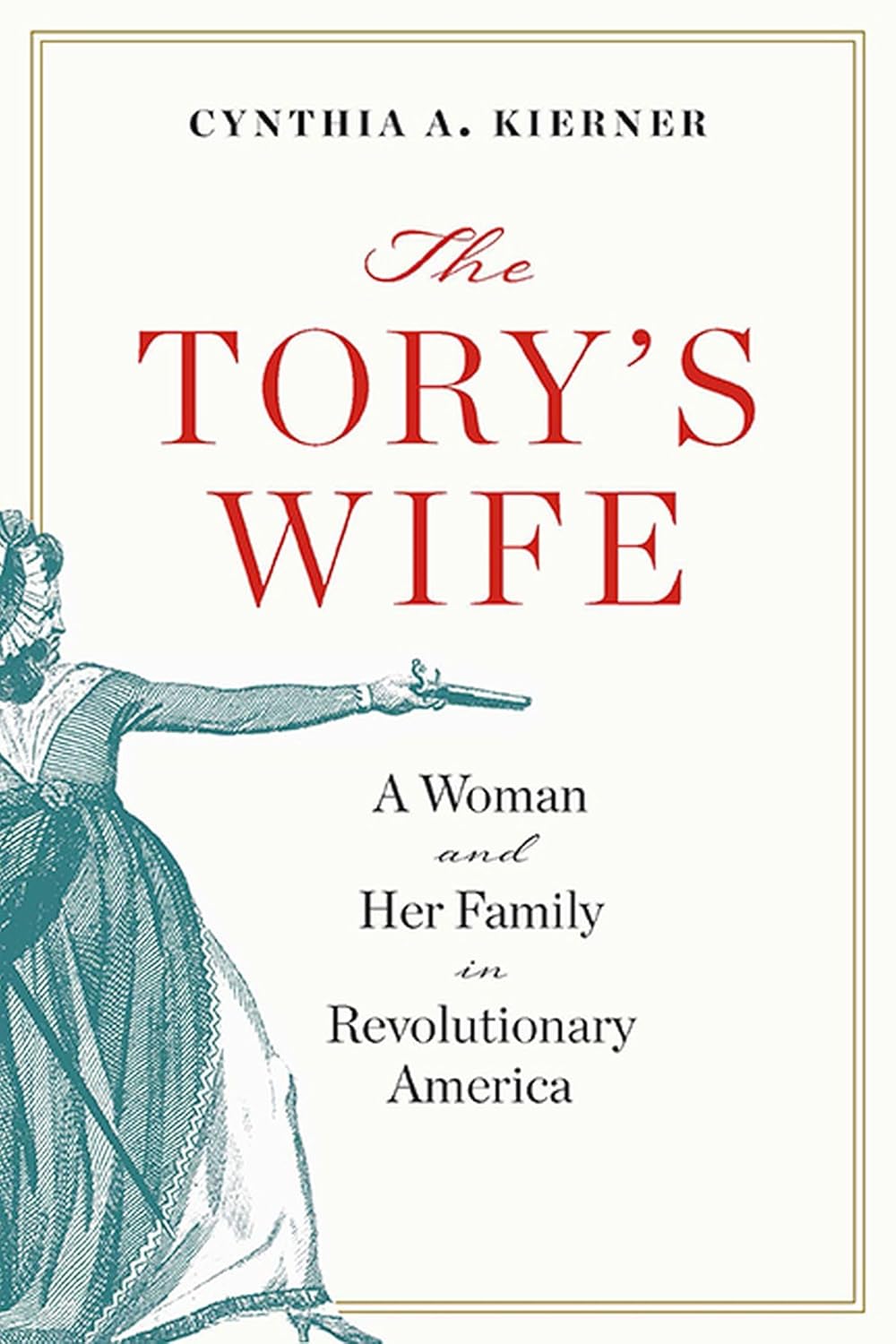
The Spurgin family of North Carolina experienced the cataclysm of the American Revolution in the most dramatic ways―and from different sides. This engrossing book tells the story of Jane Welborn Spurgin, a patriot who welcomed General Nathanael Greene to her home and aided Continental forces while her loyalist husband was fighting for the king as an officer in the Tory militia. By focusing on the wife of a middling backcountry farmer, esteemed historian Cynthia Kierner shows how the Revolution not only toppled long-established political hierarchies but also strained family ties and drew women into the public sphere to claim both citizenship and rights―as Jane Spurgin did with a dramatic series of petitions to the North Carolina state legislature when she fought to reclaim her family’s lost property after the war was over.
While providing readers with stories of battles, horse-stealing, bigamy, and exile that bring the Revolutionary era vividly to life, this book also serves as an invaluable examination of the potentially transformative effects of war and revolution, both personally and politically.