
![William Moultrie, by Charles Wilson Peale. Courtesy, National Portrait Gallery [NPG.65.57]](https://mtv-drupal-assets.s3.amazonaws.com/files/resources/william_moultrie_by_peale.jpg?VersionId=moLlmzJ4NHJ6I37x80y5nONngr8zu54P)
William Moultrie was South Carolina’s highest-rankling Continental officer, finishing the Revolutionary War with the rank of major general. After the war, he served as the president of the Society of the Cincinnati of the State of South Carolina from 1784 until his death. Before the Revolutionary War, he served on colonial assemblies. From 1785 to 1787 and 1792 to 1794, he served as governor of South Carolina. As a planter in the lowcountry of South Carolina, he enslaved over two-hundred people.
Early Life
Moultrie was born in Charleston in 1730. His father John Moultrie was a physician and Scottish immigrant, and his mother was Lucretia Cooper Moultrie. He married Damaris Elizabeth St. Julien in 1749. Through his marriage, he rose in social standing and wealth, subsequently gaining her family property North Hampton Plantation and those enslaved there. Gaining influence, he served on the Commons House of Assembly. In 1761, he participated in the Anglo-Cherokee War in the interior of the South Carolina colony. This conflict was a part of the Seven Years' War, as settlers encroached onto Cherokee land, souring their previous alliance.
Service in the American Revolution
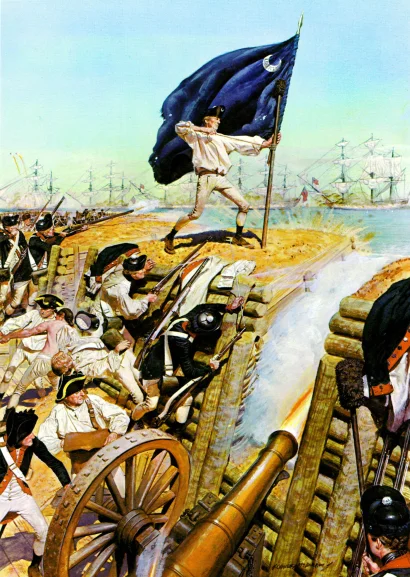
In 1775, Moultrie commissioned as a colonel. As British forces led by Sir Henry Clinton attempted to capture Charleston, Moultrie led a brave and dramatic defense of a small fort constructed of sand and palmetto logs on Sullivan’s Island at the entrance to its harbor in June of 1776. Moultrie’s success against what seemed to be an irresistible British naval attack denied Charleston to the British and temporarily prevented the establishment of a British foothold in the south. With this success, Washington expressed interest in Moultrie. Maj. Gen. Charles Lee wrote to Washington a few days after the battle that Moultrie deserved the highest honors. Moultrie subsequently received the thanks of the Continental Congress and a promotion to the rank of brigadier general.1

In 1779, General Moultrie managed a tactical retreat through the South Carolina lowcountry. They briefly withstood a British siege of Charleston from the landward side by Brig. Gen. Augustine Prévost. Moultrie was second-in-command under Maj. Gen. Benjamin Lincoln when Charleston finally capitulated to Maj. Gen. Sir Henry Clinton in May 1780.
As the senior ranking Continental prisoner of war in Charleston, he honorably advocated on behalf of his fellow captives against their sometimes-harsh British captors. When offered an opportunity to desert to the British in order to regain his freedom and lost property, he refused. To the former British governor of South Carolina Charles Greville Montague he declared, “Could I be guilty of so much baseness I should hate myself and shun mankind.”2
William Moultrie and George Washington became personally acquainted on August 30, 1781, when their paths crossed at a dinner given in Philadelphia at the home of Robert Morris. Moultrie was on parole from captivity in Charleston and Washington was en route to Yorktown. The two generals did not meet again for a decade though they periodically corresponded on such matters as the Society of the Cincinnati, the construction of a canal in South Carolina, and coastal defense.3
Political Career After the American Revolution
Moultrie was popular for his service after the war, and had a colonial political background. His post-war political career began as the Lieutenant Governor of South Carolina from 1784 to 1785. From 1785 to 1787 and 1792 to 1794, he served as governor of South Carolina. He was active governor when President Washington visited South Carolina during his 1791 southern tour, and during that period Moultrie served as his host and escort, accompanying the president to parades, balls, banquets, tours, and private dinners. They visited the site of Moultrie’s 1776 triumph against the British on Sullivan’s Island, and they walked the battle lines of the catastrophic 1780 siege of Charleston.4
Moultrie entertained Washington in his home on the evening prior to the president’s departure from Charleston. Afterwards, he shipped to Mount Vernon a number of plants desired by Washington. It is evident from their correspondence during this interval that the two old soldiers had formed a bond of friendship. Moultrie always considered the time of Washington’s visit among his happiest days. Both men anticipated with pleasure the fulfillment of Washington’s open invitation for General and Mrs. Moultrie to visit Mount Vernon.5
A friendship between Washington and Moultrie did not last. An escalation of the French Revolution (1789–1799) threatened to draw the nascent United States into an international conflict. Moultrie, during his second term as governor of South Carolina, embraced republican ideology and subverted the president’s foreign policy by allowing the arming of French privateers in Charleston. The Washington administration ordered him to end his support of the French, and for a while rumors circulated in the press that he would face impeachment for his actions.6
Moultrie’s estrangement with President Washington lessened by Moultrie’s friendship with the young French minister Edmond Charles Genet (Citizen Genet). Genet’s efforts to circumvent presidential authority, provoked the president to demand his recall by the French government. For his involvement with Genet, Moultrie was excoriated in the Federalist press.7
Financial struggles left Moultrie practically destitute in his latter years. In 1802, he managed to assemble and publish his personal papers as the two-volume Memoirs of the American Revolution, an important primary source that is often quoted in other works and is still regarded as one of the best personal accounts of the Revolutionary War. William Moultrie is credited with designing South Carolina’s first state flag, “a large blue flag made with a crescent in the dexter corner.” His heroic 1776 defense of Sullivan’s Island was later commemorated by the addition of a palmetto tree to the flag. This rendition of South Carolina’s flag remains in use to the present.8
C. L. Bragg
Notes:
1. Charles Lee to George Washington, July 1, 1776, Papers of George Washington: Revolutionary War Series 5:168–70; John Hancock to William Moultrie, July 22, 1776, Papers of the Continental Congress, 1774-1789, National Archives microfilm series M247, roll 177 (vol. 2): 533, 539.
2. William Moultrie to Charles Montague, March 12, 1781, The Correspondence of Lord Montague with General Moultrie, 1781, compiled by William Ashmead Courtenay (New York: T. L. De Vinne, 1885), 13–15.
3. Pennsylvania Packet (Philadelphia, Pa.), Saturday, September 1, 1781; William Moultrie to George Washington, February 23, 1787, Papers of George Washington: Confederation Series 5:48; Moultrie to Washington, April 7, 1786, Washington to Moultrie, May 25, 1786, and Moultrie to Washington, August 7, 1786, Papers of George Washington: Confederation Series 4:6–7, 73–75, 201–2; Moultrie to Washington, February 15, 1793, and Washington to Moultrie, March 15, 1793, Papers of George Washington: Presidential Series 12:147–48, 321–22.
4. City Gazette (Charleston, S.C.), May 14, 1791.
5. bid.; Moultrie to Washington, July 10, 1791, and November 28, 1791, George Washington Papers, LOC, Series 4, General Correspondence; Washington to Moultrie, August 9, 1791, Papers of George Washington: Presidential Series 8:415; Washington to Moultrie, November 8, 1791, and Moultrie to Washington, December 29, 1791, Papers of George Washington: Presidential Series 9:154–55, 346; Washington to Moultrie, March 14, 1792, and Washington to Moultrie, May 5, 1792, Papers of George Washington: Presidential Series 10:109, 355.
6. City Gazette (Charleston, S.C.), January 15, 1793, and January 21, 1794; William Moultrie to the Council of Safety of France, August 9, 1794, Moultrie Papers, box 1, folder 21, South Caroliniana Library, University of South Carolina, Columbia, S.C.; Edmond Charles Genet to Thomas Jefferson, May 27, 1793, American State Papers, Foreign Relations 1: 149–50; Editorial note accompanying Henry Knox to George Washington, May 24, 1793, Papers of George Washington: Presidential Series 12: 623, 624n2.
7. Moultrie to Washington, April 21, 1793, Papers of George Washington: Presidential Series 12:463; Columbian Herald (Charleston, S.C.), November 9, 1793.
8. William Moultrie, Memoirs of the American Revolution so far as it Related to the States of North and South-Carolina, and Georgia, vol. 1 (New York: David Longworth, 1802), 90–91.
Sources:
Bragg, C. L. Crescent Moon Over Carolina: William Moultrie and American Liberty. Columbia, S.C.: University of South Carolina Press, 2013.
City Gazette (Charleston, S.C.), 1791–1800.
Columbian Herald (Charleston, S.C.), 1793.
Courtenay, William Ashmead, comp. The Correspondence of Lord Montague with General Moultrie, 1781. New York: T. L. De Vinne, 1885.
Moultrie, William, Memoirs of the American Revolution so far as it Related to the States of North and South-Carolina, and Georgia. 2 vols. New York: David Longworth, 1802.
Moultrie, William. Papers, 1757–1963. Manuscripts Plb. Manuscripts Division, South Caroliniana Library, University of South Carolina, Columbia, S.C.
Pennsylvania Packet (Philadelphia, Pa.), 1781.
U. S. Congress. American State Papers. Indian Affairs, Vol. 1 [1789–1814] and Foreign Relations, Vol. 1 [1789–1797]. Edited by Walter Lowrie and Matthew St. Clair Clarke. Washington: Gales and Seaton, 1832–1833.
Washington, George. The Papers of George Washington. 56 vols. in 5 series. Edited by W. W. Abbott, et. al. Charlottesville: University Press of Virginia, 1983–2011.

Digital Encyclopedia
Siege of Charleston
The 1776 Siege of Charleston, South Carolina, was a short but important military episode in the early years of the American Revolution.
Digital Encyclopedia
Southern Strategy
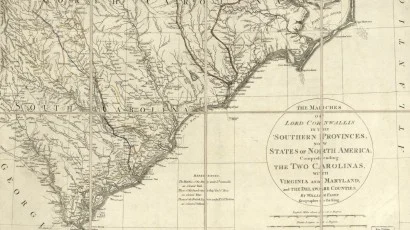
The Southern Strategy was a plan implemented by the British during the Revolutionary War to win the conflict by concentrating their forces in the rebelling southern colonies.
Historic Site
Fort Moultrie - NPS
Today Fort Moultrie has been restored, and visitors moves steadily backwards in time from the World War II Harbor Entrance Control Post to the site of the Palmetto-log fort of 1776.