

Dr. James Craik and George Washington shared decades of friendship built upon shared interests and their service together in the Seven Years’ War. After the war, Craik would continue his relationship with Washington as they travelled to western lands and in the capacity as his personal doctor. During the American Revolution, he served as a surgeon in notable engagements rising to the rank of Assistant Director General of the Medical Department of the Continental Army. His friendship with Washington continued throughout his presidency, and later in his final moments as Craik attended to Washington on his deathbed.
Early Life
Dr. James Craik was born in the parish of Kirkbean, County Kirkcudbright, near Dumfries in Scotland in July of 1730. Craik was the son of William Craik, a member of the British Parliament and the laird of Arbigland, a 1,400-acre estate on the Firth of Solway on the west coast. While not acknowledged legally as Craik’s father, he provided care and an education for him. Craik pursued medical training at the University of Edinburgh and provided medical service to the British army upon graduation. In 1750, James Craik immigrated to the West Indies to serve as an army surgeon. Soon after, however, he resigned his post and moved to Norfolk, Virginia where he opened a medical practice. Craik later moved to the frontier town of Winchester, practicing as a surgeon based at Fort Loudon.
Service in the Seven Years’ War
During the Seven Years’ War, Craik served with the Virginia Provincial Regiment as the unit surgeon and it was in this capacity he first interacted with Washington. In this role, they were both involved in important engagements. In Washington’s 1786 account of the capitulation of Fort Necessity on July 3, 1754, he recalled Craik caring for wounded members of the regiment.1 Later during what has become known as Braddock's Defeat, a failed British attempt to conquer the French-held Fort Duquesne in 1755. Craik treated Braddock's wounds until the general's death the next day. Washington then commanded the regiment until 1758. Craik continued as the group's chief medical officer until 1756. Upon retirement from the army, Craik purchased a plantation at Port Tobacco, Maryland and began a new medical practice.
Relationship Between Wars
Craik and Washington's relationship continued to grow following their military service and shared experiences during the war. In 1770, Craik accompanied Washington on a westward journey to the Ohio River Valley. On this journey, they viewed lands deeded to Washington near the Kanawha River as a result of his service in the Seven Years' War.2 They were jointly concerned about their access these lands after British measures to curb colonist from settling further west. During their travels they met with Seneca leader Guyasuta. Fourteen years later in 1784, Craik and Washington took a similar trip to observe more of Washington's western lands.

Service in the American Revolution
Craik took an early, active interest in the push towards American independence. Initially he served as an army surgeon, but rose to the role of Assistant Director General of the Medical Department of the Continental Army. He successfully treated the wounds of well-known leaders including Marquis de Lafayette after the Battle of Brandywine. He attempted to treat Hugh Mercer after the Battle of Princeton, but was unsuccessful as he succumbed to his injuries. Given his role, Craik was well regarded and connected to the officer corps. He warned Washington of the burgeoning "Conway Cabal" that sought to replace Washington as Commander-in-Chief with Horatio Gates.
After the American Revolution
After the war's conclusion, Craik moved and opened a medical practice in Alexandria, Virginia, at Washington’s urgings. He visited nearby Mount Vernon frequently. He served as Washington's personal physician when he was at home. In 1798, Washington was briefly called from his retirement to command the army in preparation for a possible war with France, and appointed Craik as the Physician General of the Army. With war averted, Craik continued his medical practice in Alexandria.
On December 13, 1799, Craik was summoned to Mount Vernon to attend to a gravely ill Washington. Serving with two other doctors, Craik repeatedly attempted to cure what ailed the sickly former president. Washington passed away the next day, despite the best efforts of his longtime friend and physician.3 Craik lived the rest of his life in Alexandria where he passed away in 1814 and was buried in the cemetery of the Old Presbyterian Meeting House. He remained a popular figure in the Alexandria community until his death and was well known for his connection with the first president, often socializing with other leading political figures of this time.
Adam D. Shprintzen, Ph.D. Marywood University, Revised by Zoie Horecny, Ph.D., 8 October 2025
Notes:
1. “IV. George Washington’s Account of the Capitulation of Fort Necessity, [1786].” The Papers of George Washington, Colonial Series, vol. 1, 7 July 1748 – 14 August 1755, ed. W. W. Abbot (Charlottesville: University Press of Virginia, 1983), 172–173. Washington documented this experience with Craik to David Humphreys, a former aide de camp, who was working on a history of the American Revolution at Mount Vernon. While it is uncertain if this was their first time interacting with one another, it is the earliest encounter between the two men cited by Washington.
2.“Remarks & Occurrs. in October [1770],” Founders Online, National Archives.
3.“II, 14 December 1799,” Founders Online, National Archives, in Tobias Lear’s Narrative Accounts of the Death of George Washington.
Bibliography:
Chernow, Ron. Washington: A Life. Penguin Publishing Group, 2010.
Custis, George Washington Parke. Recollections and Private Memoirs of Washington. Washington, DC: Moore, 1859.
Duncan, Louis C. Medical Men in the American Revolution, 1775-1783. Carlisle Barracks, PA: Medical Field Service School, 1931.
Moore, Robert Walton and Merritte Weber. Dr. James Craik, A Revolutionary General. 1928.
Pilcher, James Evelyn. The Surgeon Generals of the Army of the United States of America: A Series of Biographical Sketches of the Senior Officers of the Military Medical Service from the American Revolution to the Philippine Pacification. Carlisle, PA: Association of Military Surgeons, 1905, 21–24.

James Craik
| Born: | c. 1730, Kirkbean, Scotland |
| Died: | February 6, 1814, Alexandria, Virginia |
| Occupation: | Surgeon |
| Military Service: | Surgeon in the British Army (1751); Surgeon to the Virginia Provincial Regiment (1754-1756); Surgeon and Assistant Director General of the Middle Department of the Continental Army (1774-1783); Physician General to the United States Army (1798-1800) |
| Other Notes: | Close friend of George Washington; present at Washington's death |
Digital Encyclopedia
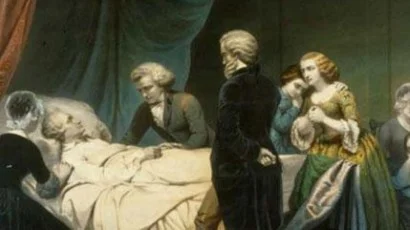
The Death of George Washington
James Craik was one of three physicians who attended Washington in the days leading up to his death on December 14, 1799.
Digital Encyclopedia
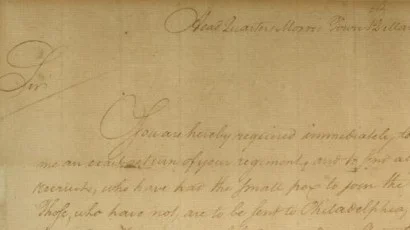
Smallpox
As a physician for the army, James Craik would have been familiar with smallpox, one of the great biological threats to armies during the American Revolution.
History of Medicine

"This Melancholy Call": Washington and Cancer
Learn more about 18th century medical practices through this article on the cancer treatments in Washington's family.