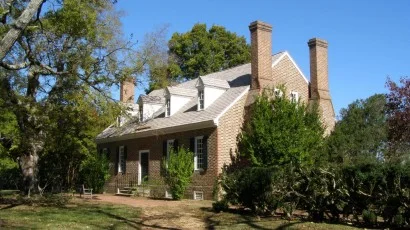
George Washington spent his childhood at the property later known as Ferry Farm. The Washington family often referred to it as Home House or Home Farm. The property was located on the northern bank of the Rappahannock River across from Fredericksburg, Virginia. In 1738, Augustine Washington moved to Ferry Farm with his wife, Mary Ball Washington, and their five young children including six-year old George. It is the setting for much of the existing mythology of George Washington's childhood derived from Parson Mason Locke Weems' Life of Washington. One of the most famous and enduring myths is of Washington chopping down a cherry tree at Ferry Farm.1 However, the property functioned not only as the Washington family home, but also a site where enslaved people lived and labored. At the time of his Augustine Washington’s death in 1743, he enslaved at least twenty-one people at Ferry Farm.2
Under the Ownership of Augustine Washington
Augustine Washington purchased the advantageously located 280-acre property later known as Ferry Farm from the Strother family in 1738. He expanded his landholdings there over time, renting an adjoining 300-acre tract. The farm was conveniently located near the Little Falls Run property that Mary Ball Washington had inherited from her father, as well as Augustine Washington's iron works located at Accokeek Creek.3
A dwelling already stood on the site when the Washington family took possession of the property from the Strother family. The one-and-one-half story frame building had four rooms below with a central hall, four rooms above, and a sixteen-by-sixteen-foot cellar. The foundation, stone-lined cellars, and two root cellars of the Washington home were located in 2008, and archaeological excavations are ongoing. The evidence revealed that the house was a clapboard-covered wooden structure of one-and-one-half stories with two end chimneys. Archaeologists also found evidence of a fire that damaged the dwelling in December of 1740. However, it appears to have been contained to a small portion of the house, and the Washington family resumed living there soon afterwards. Excavators also found the remains of a kitchen and quarters for enslaved people, as well as numerous eighteenth-century artifacts. This supports that up to approximately twenty people were enslaved at the site at any given time, as the Strother family enslaved twenty-two people at the property under their ownership and both families used these same dwellings as housing for the enslaved.4
Primarily involved in growing tobacco, corn, and wheat, Augustine sought to diversify his income through wool production and iron manufacturing. However, neither endeavor was particularly successful.5A ferry ran between the Washington property and Fredericksburg, situated on the opposite bank of the Rappahannock River, which connect the family to their neighbors and markets. These are the origins of the name “Ferry Farm,” but the ferry was never operated by the Washington family.6
Under the Ownership of George Washington
Augustine Washington died in 1743 at the age of forty-nine, just five years after the family had moved to Ferry Farm. At that time, George Washington inherited the farm and was to one day inherit ten enslaved people, but the farm and those who labored on it remained under his mother’s management until he was twenty-one years old.7 Like her son, Mary Ball Washington was interested in planting and planted garden for her own personal use at the property. It was at Ferry Farm that Washington learned the principles of agriculture, a passion that would endure throughout his life. However, Washington spent much of his time away from Ferry Farm once he began surveying work at the age of sixteen. The farm remained Washington’s principal residence until he moved to Mount Vernon in 1754 after his brother Lawrence's death.
In 1750, George Washington turned eighteen, and the Washington family began to divide those the family enslaved following the parameters of Augustine Washington’s will as his sons approached legal age. By this time, his father’s estate total at least fifty-five people across various properties throughout Prince William, Stafford, King George, Spotsylvania, and Westmoreland counties. Often, the Washington family moved these individuals to different properties based on labor needs. Ultimately, fifty-five named enslaved individuals were distributed between George Washington, his mother, and his brothers Samuel, John Augustine, and Charles.8 In this division, eleven individuals were inherited by George Washington (initially, he was willed ten enslaved people), and he moved many to work at his newly purchased property Bullskin plantation in Frederick County.

Mary Ball Washington continued to reside in the family’s home on Ferry Farm, and she managed those enslaved there at any given time. She assumed most of its profits despite Washington’s legal ownership after the age of twenty-one. After various conflicts about money, George Washington became more closely involved with its management in the early 1770s.9 Having experimented with crop rotations at Mount Vernon, he hoped to make the property more profitable, and he surveyed the land. In 1771, he arranged for Edward Jones to continue as the overseer at Ferry Farm and in exchange, he would receive a portion of the agricultural output.10 In 1772, George Washington bought his mother a house in Fredericksburg. At this time, George Washington completely assumed the management of Ferry Farm.11 Under his management, he began to transport enslaved workers from one of the outlying farms of Mount Vernon, such as Muddy Hole Farm, to assist with harvests. In addition to managing Ferry Farm, he also rented his mother’s property Little Farms.12
Although he was becoming more actively involved with managing Ferry Farm at this time, he quickly began preparations to sell the property. In 1774, Washington sold the 600 acre farm for two thousand pounds to Hugh Mercer, a Scottish immigrant and physician who served as a brigadier general in the Revolutionary forces.13
Originally researched by Gwendolyn K. White Ph.D. Candidate, American History George Mason University, updated by Zoie Horecny, 12 November 2025
Notes:
1. Mason L. Weems, The Life of Washington, ed. Marcus Cunliffe (Cambridge, MA: Harvard University Press, 1962), 10-13; Edward G. Lengel, Inventing George Washington: America's Founder in Myth and Memory (New York: Harper Collins Publishers, 2011), 21-22.
2. Dave Muraca, Paul Nasca, and Phil Levy, “Report on the excavation of the Washington Farm: The 2002 and 2003 Field Seasons.” The George Washington Foundation. 2011; "An Enslaved Residents’ Quarter at the Washington-Era Ferry Farm Site (George Washington’s Boyhood Home National Historic Landmark): Archaeological and Historical Documentation and Evidence for Proposed Implementation of Phrase 1-B of a Landscape Rehabilitation,” Prepared by David Muraca and Mark R. Wenger, George Washington Foundation, March 2021; "Will of Augustine Washington, 11 April 1743," George Washington Papers at the Library of Congress, 1741-1799: Series 4. General Correspondence. Those listed as enslaved by Augustine Washington at Ferry Farm at the time of his death in his probate (King George County Inventory and Appraisals 1:285) are: Jack, Bob, Ned, Dick, Ned, Toney, Steven, Jo, London, George, Jcumy, Jack, Lucy, Sue, Judy, Nan, Betty, Jenny, Phillis, Hannah, and Mary. Sue’s daughter Mary is named separately as bequeathed to his daughter Betty Fielding Lewis, meaning she was likely living at Ferry Farm with her mother at the time of Augustine’s death.
3. Jack D. Warren, Jr. "The Childhood of George Washington," Northern Neck of Virginia Historical Magazine 9, No. 1., 5789.
4. "An Enslaved Residents’ Quarter at the Washington-Era Ferry Farm Site (George Washington’s Boyhood Home National Historic Landmark): Archaeological and Historical Documentation and Evidence for Proposed Implementation of Phrase 1-B of a Landscape Rehabilitation,” Prepared by David Muraca and Mark R. Wenger, George Washington Foundation, March 2021; . Dave Muraca, Paul Nasca, and Phil Levy, “Report on the excavation of the Washington Farm: The 2002 and 2003 Field Seasons.” The George Washington Foundation. 2011.
5. Jack D. Warren, Jr. "The Childhood of George Washington," Northern Neck of Virginia Historical Magazine 9, No. 1., 5787.
6. Ibid., 5788. The farm, known as Washington Farm or Home Farm during the family's tenure, acquired the name Ferry Farm at some point in the nineteenth century. George Washington purchased the 300 acres his father had rented sometime before 1774.
7. "Will of Augustine Washington, 11 April 1743," George Washington Papers at the Library of Congress, 1741-1799: Series 4. General Correspondence. 1697-1799; “Deed for Ferry Farm Land, 7 July 1748,” Founders Online, National Archives. When those enslaved by his father’s estate are divided they divided using the appraised value of individuals, and Washington ultimately inherits eleven enslaved people.
8. Papers of George Washington, Colonial Series: 7:173-5n. Also found in “Memorandum Division of Slaves, 1762,” Founders Online, National Archives. Often, individuals were moved from property to property in accordance to labor needs and as Augustine and Mary’s son grew of age and purchased their own properties. Given the size of Ferry Farm and the dwellings on the site in which enslaved people lived, approximately twenty people were enslaved there at any given time. This aligns with Augustine Washington’s probate that twenty-one people were enslaved at Ferry Farm at the time of his death in 1743.
9. “Cash Accounts, April 1772,” Founders Online, National Archives.
10. “Remarks & Occs. in Septr. [1771],” Founders Online, National Archives.
11. “Account with Mary Washington, 27 April 1775,” Founders Online, National Archives.
12. Papers of George Washington, Colonial Series, 8:522.
13. “George Washington to Hugh Mercer, 28 March 1774,” Founders Online, National Archives.
Note: The "Ferry Farm" purchased by George Washington and later a part of "Union Farm," was not the same "Ferry Farm" near Fredericksburg, Virginia, where Washington lived and later inherited, which is the subject of this article.
Bibliography:
Ferling, John E. The First of Men: A Life of George Washington. Knoxville: The University of Tennessee Press, 1988.
Freeman, Douglas Southall. George Washington: A Biography, Vol. 2. New York: Scribner, 1948-57.
Haulman, Kate. The Mother of Washington in Nineteenth Century America. Oxford University Press, 2025.
Levy, Philip. Where the Cherry Tree Grew: The Story of Ferry Farm, George Washington's Boyhood Home. New York, New York: St. Martin's Press, 2013.
Levy, Phillip. “Upon This Land: Seven Generations of the Washington Family and Residents of Popes Creek and Mattox Neck.” A History Resource Study for George Washington Birthplace National Monument. March 2023.
David Humphreys' "Life of General Washington" with George Washington's Remarks. Ed. Rosemarie Zaggari. Athens: University of Georgia Press, 1991.
Saxton, Martha. The Widow Washington: The Life of Mary Washington. Farrar, Straus, and Giroux, 2019.