The Continental Navy (1775-1785) was the first federally created naval force in the history of the United States. As commander in chief of the army during the American Revolution, George Washington was also integral to the establishment of maritime forces, including the Continental Navy.
Origins of the Continental Navy
The U.S. Navy marks its beginning on October 13, 1775, but that date is just one of many that might mark its founding. American revolutionaries employed many types of naval forces throughout the war, including everything from vessels built by the Continental Congress for the war, to whaleboats purchased by individual states to serve as coastal defense, to vessels owned by private citizens who fitted them out at their own expense as privateers.
The North American colonies were deeply tied to the sea, so it is not surprising that maritime warfare was present from the beginning of the conflict. In June of 1775, American insurgents captured a British warship, HMS Margaretta, in Machias, Maine (then part of Massachusetts) along with a Loyalist’s vessel, the Unity.1 These insurgents turned the Unity into a warship—the Machias Liberty—and sent it out hunting for British ships. Though the attack on the Margaretta did not have the sanction of any governing body higher than the local government, it is perhaps the first naval action of the war.
The capture of the Margaretta had little strategic purpose, but as supplies grew short for the Continental Army in 1775, General George Washington began to use ships to interdict supplies from British army transports. On September 2, 1775, he ordered Captain Nicholson Broughton to command a ship called Hannah, which had been armed for Washington by Colonel John Glover of Marblehead, Massachusetts. The Hannah – and ultimately seven other vessels – were vessels technically under Army control, authorized to hunt for British transports and supply ships.2 However, these ships were less effective than Washington had hoped, and their captains had as many catastrophes as successes.3
Authorization from the Continental Congress
Washington hired these ships without consulting the Continental Congress, but Congress had the same idea about using ships to interdict critical British supplies. On October 13, 1775, the same day the Congress learned that Washington already had ships in his employ, they authorized the fitting out of two armed vessels to go after two British powder ships that were coming to Quebec.4 This action officially marked the creation of a federal naval force (though it was not yet called the Continental Navy). Over the next few months, Congress purchased 8 ships and created a naval committee to supervise the actions of this new fleet.
In December 1775, Congress authorized the building of 13 frigates in addition to the 8 vessels already purchased.5 This new navy expanded its remit from supply interdiction to other tasks. The first major naval operation of the war fell to Commodore Esek Hopkins, who was ordered in January 1776 to destroy a British flotilla controlled by Lord Dunmore in the Chesapeake and then cruise off the Southern states.6 Instead, Hopkins chose to go to the lightly guarded Bahamas and take the garrison. Though he did take Nassau, the cruise turned into a political and logistical disaster for Hopkins and the Continental Congress.7
Functions of the Continental Navy
Over the next few years, the navy engaged in tasks such as convoy, commerce protection, and even some single-ship battles with British vessels. Additionally, the navy transported American officials such as John Adams, and French officials such as the Marquis de Lafayette, to France. At no point did the American navy ever fight a fleet battle against the expansive Royal Navy. Only once France joined the war was the United States able to marshal a substantial fleet to match the British.
Alongside Continental Navy vessels, hundreds if not thousands of American privateers fitted out to attack British shipping. For many sailors, privateering was a more attractive option than Continental Navy service because the cruises were shorter and the pay could be better, depending on the success of the cruise.8 Likewise, 11 of the 13 states outfitted vessels of some kind. Most of these vessels were not oceangoing; instead, they were harbor and coastal defense crafts that were used in only a small area. A few states did fit out large warships, though those vessels were not particularly successful.
Most of the captains and crews of the Continental Navy and the other naval forces were inexperienced in naval discipline and in naval strategy. Even though the Continental Congress did issue naval regulations written by John Adams, captains struggled to maintain order and discipline on board their ships.9 Mutiny or near-mutiny was a common threat to captains. Moreover, the crews of naval vessels moved regularly between Continental ships, privateers, and land forces.10 Finding enough men was a constant problem.
Key Engagements
Despite all these barriers, the Continental Navy did have some success in taking British ships. Captain Gustavus Conyngham was so successful in his captures around the English coast that he was labeled the “Dunkirk Pirate.”11 Similarly, Captain Lambert Wickes, commodore of a three-ship squadron, captured 15 ships in 5 days in 1777 before his ship was lost at sea.12 The most famous captain of the Continental Navy was John Paul Jones, who commanded four naval vessels and was successful in each of them. His most famous battle was in September 1779 off Flamborough Head, where his ship, Bonhomme Richard, along with the American frigate Alliance and a French ship, engaged HMS Serapis and HMS Countess of Scarborough. Though Bonhomme Richard sank out from under him, Jones captured both British vessels.13
Any good news was vital for the Continental Navy in 1779, as the biggest naval expedition of the war turned into the biggest naval defeat for the United States until Pearl Harbor. In July 1779, Commodore Dudley Saltonstall led a 44-ship armada to the Penobscot Bay in Maine, hoping to take a British stronghold near modern-day Castine, Maine. This armada combined Continental Navy ships, Massachusetts state navy ships, and even some privateers, along with troop transports carrying more than 1,000 troops. The Americans waited in the bay for nearly three weeks without mounting a serious assault, giving the British time to send reinforcements. When the Americans did begin a real assault, it ended with the Americans fleeing up the Penobscot River. The ships that were not captured by the British were burned by their own crews to keep them from falling into the hands of the British, and the American sailors and soldiers had to make their way on foot through the backwoods of Maine. Every ship was lost.14
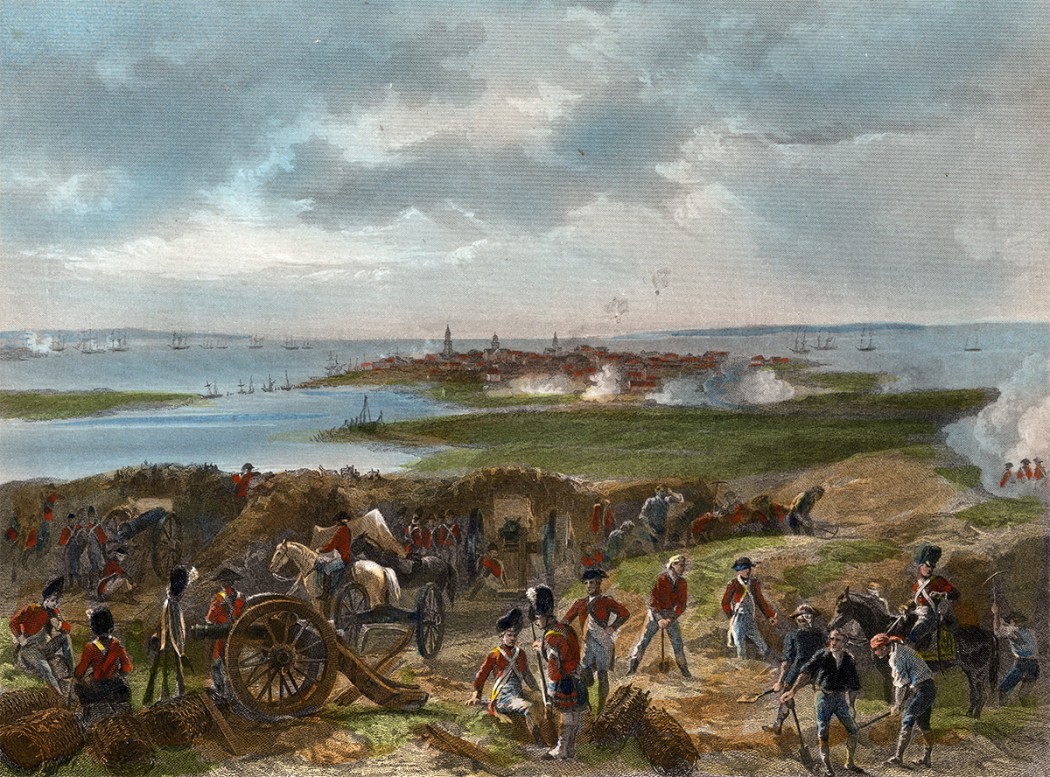
The Siege of Charleston in 1780 proved just as costly to the American cause. Because the British army besieged Charleston from the land, the American army commanders asked the naval vessels to send their crews to support the beleaguered forts. Ultimately, four more Continental vessels were lost at Charleston.15
After the American Revolution
By the end of the war, only the Continental frigate Alliance remained. In 1785, even Alliance was sold, as the political winds had shifted away from any desire to have a fulltime standing navy.16 It would be nine more years before Congress again considered whether the United States needed a navy. In 1794, in response to a threat from the Barbary state of Algiers, Congress once again authorized a naval building program. Since that time, the United States has never been without a navy.
Abby Mullen, Ph.D. United States Naval Academy
Notes:
1. M.D. Giambattista, “Captain Jeremiah O'Brien and the Machias Liberty,” Proceedings of the United States Naval Institute 96/2/804 (February 1970). https://www.usni.org/magazines/proceedings/1970/february/captain-jeremiah-obrien-and-machias-liberty
2. Vincent S. Dowdell Jr., “The Birth Of The American Navy,” Proceedings of the United States Naval Institute 81/11/633 (November 1955). https://www.usni.org/magazines/proceedings/1955/november/birth-american…
3. William M. Fowler, Rebels under Sail: The American Navy during the Revolution (Scribner, 1976), 29-36.
4. Fowler, 55.
5. Journal of the Continental Congress, 13 December 1775. Naval Documents of the American Revolution, ed. William Bell Clark, 13 vols. (Naval History Division, 1964), 3:90.
6. Naval Committee to Commodore Esek Hopkins, 5 January 1776. Naval Documents of the American Revolution, ed. William Bell Clark, 13 vols. (Naval History Division, 1964), 3:637-38.
7. William Fowler, “Esek Hopkins,” in James C. Bradford, Quarterdeck and Bridge: Two Centuries of American Naval Leaders, 1st ed. (Naval Institute Press, 2013), 10.
8. Sandra Moats, Navigating Neutrality: Early American Governance in the Turbulent Atlantic (University of Virginia Press, 2021), 19-20.
9. William Fowler, “Esek Hopkins,” in James C. Bradford, Quarterdeck and Bridge: Two Centuries of American Naval Leaders, 1st ed. (Naval Institute Press, 2013), 6.
10. For examples, see Christopher P. Magra, “‘Soldiers... Bred to the Sea’: Maritime Marblehead, Massachusetts, and the Origins and Progress of the American Revolution,” The New England Quarterly 77, no. 4 (2004): 552-53.
11. Lord Stormont to Lord Weymouth, 14 May 1777. Naval Documents of the American Revolution, ed. William Bell Clark, 13 vols. (Naval History Division, 1964), 8:846.
12. Fowler, Rebels Under Sail, 123-24.
13. James C. Bradford, Quarterdeck and Bridge: Two Centuries of American Naval Leaders, 1st ed. (Naval Institute Press, 2013), 25-26.
14. Fowler, Rebels Under Sail, 109.
15. Carl P. Borick, A Gallant Defense: The Siege of Charleston, 1780 (University of South Carolina Press, 2003), 224.
16. Fowler, Rebels Under Sail, 85.
Bibliography:
Borick, Carl P. A Gallant Defense: The Siege of Charleston, 1780. University of South Carolina Press, 2003.
Bradford, James C. Quarterdeck and Bridge: Two Centuries of American Naval Leaders, 1st ed. Naval Institute Press, 2013.
Dowdell Jr., Vincent S. “The Birth Of The American Navy,” Proceedings of the United States Naval Institute 81/11/633: November 1955.
Fowler, William M. Rebels under Sail: The American Navy during the Revolution. Scribner, 1976.
._____ “Esek Hopkins,” in James C. Bradford, Quarterdeck and Bridge: Two Centuries of American Naval Leaders, 1st ed. Naval Institute Press: 2013.
Giambattista, M.D. “Captain Jeremiah O'Brien and the Machias Liberty,” Proceedings of the United States Naval Institute 96/2/804: February 1970.
Magra, Christopher P. “‘Soldiers... Bred to the Sea’: Maritime Marblehead, Massachusetts, and the Origins and Progress of the American Revolution,” The New England Quarterly 77, no. 4: 2004.
Moats, Sandra. Navigating Neutrality: Early American Governance in the Turbulent Atlantic. University of Virginia Press, 2021.