
Mount Vernon's preservation team is constantly working to restore and preserve George Washington's estate.
1. The Mount Vernon Ladies’ Association owns George Washington’s home.

In the 1860s, George Washington’s estate was purchased from the Washington family by the Mount Vernon Ladies’ Association. Since then, the organization has worked to preserve Washington’s home to how it appeared in 1799, the year he died.
2. Extensive research is done before every restoration project.
Prior to the start of a restoration or preservation project, Mount Vernon’s experts examine a wide variety of evidence. This can include letters, diaries, receipts, invoices, financial accounts, drawings, paintings, prints, photographs, and building fabric including woodwork, plaster, masonry, flooring, framing, and wallpaper fragments.
3. Mount Vernon's red roof was not always red.
Shingles found in the roof were painted slate blue, which, combined with documentary evidence of the same, indicate that the roof was likely this color from as early as 1775. The roof was red by 1793 when Edward Savage did two paintings of the Mansion, with the now iconic red roof.
Membership
Become a Member of Mount Vernon
As a privately funded institution we rely upon people just like you to help keep George Washington's legacy alive.
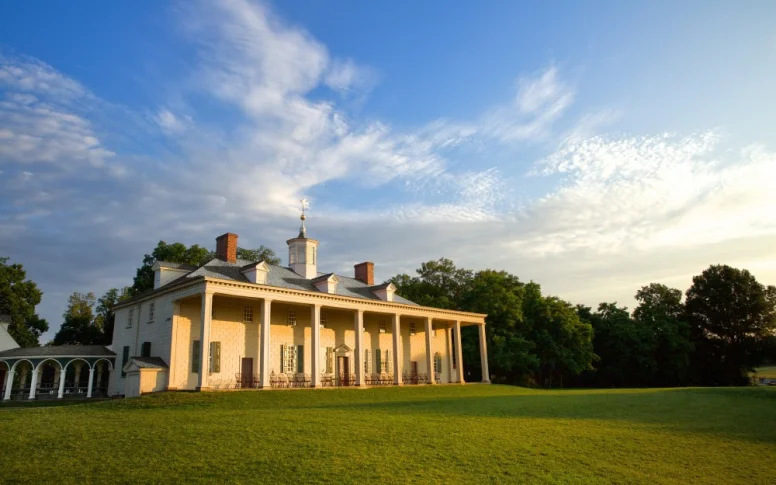
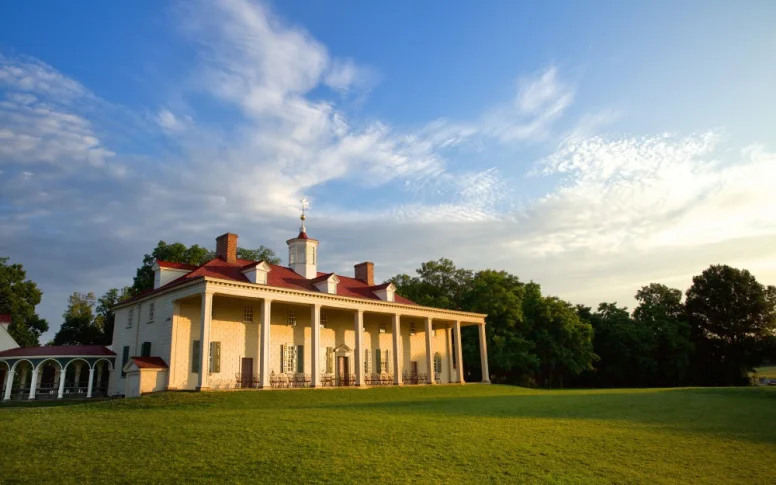
An artist rendering of the Mansion with a slate blue roof compared to the red roof.
4. The exterior siding of the Mansion is wood.
The southern yellow pine wood used to make the siding has been rusticated or made to look like stone.
The siding boards are cut to resemble stone blocks and then paint and sand are applied to achieve a stone-like texture. The application of paint and sand is periodically repeated to protect the siding from the elements and to keep the Mansion looking like it did during Washington’s life.
5. There are 15 original structures from George Washington’s life still standing.
They are the Mansion, spinning house, salt house, gardener’s house, servants hall, north colonnade, kitchen, store house, smokehouse, wash house, stable, ice house, Old Tomb, south garden house, and north garden house.
There are also portions of several garden walls that survive from the 18th century. And, while the New Tomb was built after the Washingtons’ deaths, it survives from the 1830s. These are complemented by a number of reconstructed and replica structures across the estate.
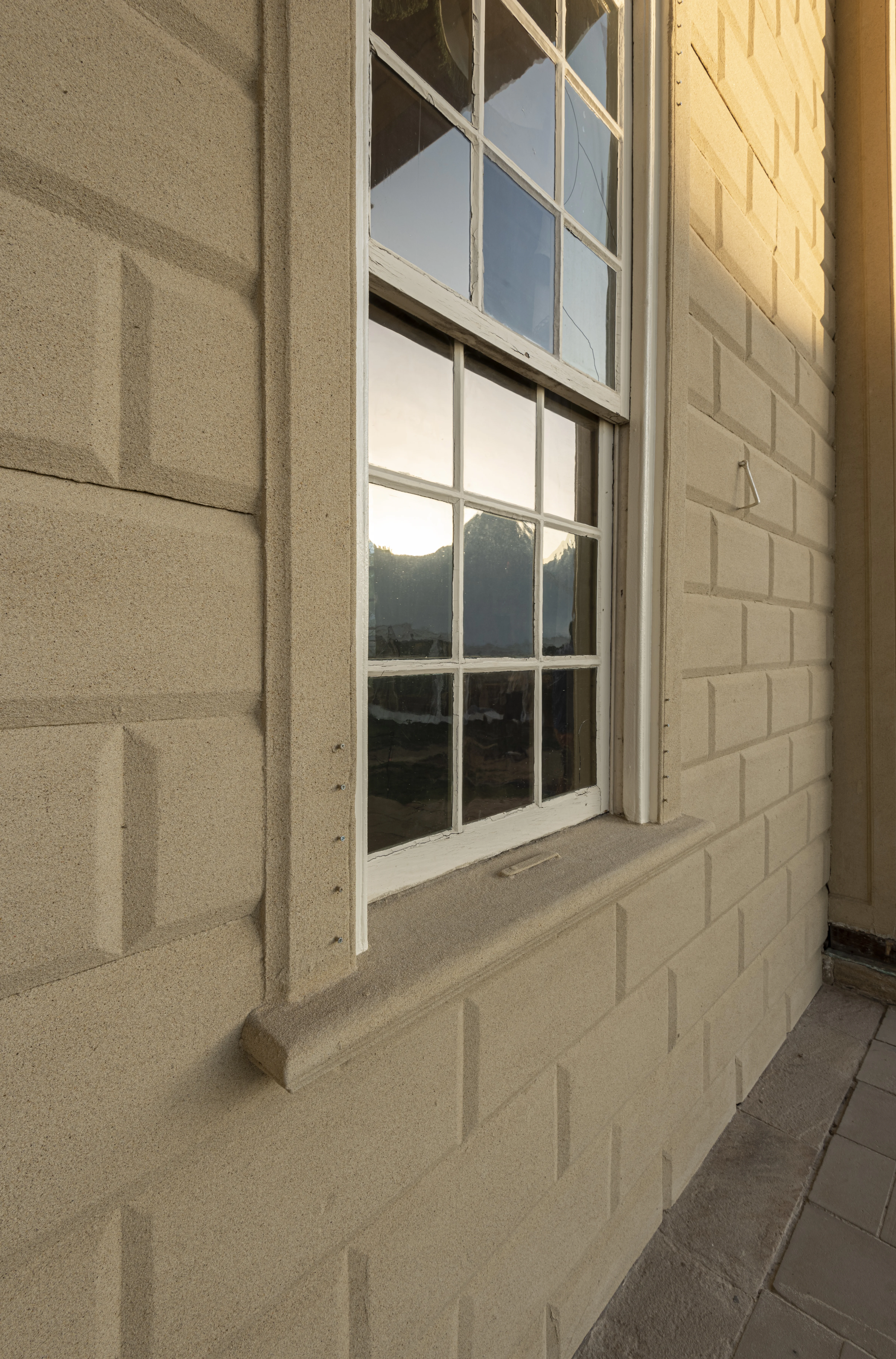
Rusticated siding on the Mansion’s east front after 2023 restoration. MVLA.
6. The restoration of the Front Parlor was inspired by a previously unknown document.
In 2013, Mount Vernon acquired a previously-unknown ledger kept by George William Fairfax, the Washingtons’ friend and owner of the nearby Belvoir plantation. This ledger provided detailed information on a suite of furniture that Fairfax acquired in London for Belvoir’s “blue dressing chamber.”
We knew that when Fairfax moved to England in 1774, he gave Washington the dressing room furniture, but prior to the appearance of the ledger, we had no idea what this furniture looked like. This furniture was recreated and placed in the Front Parlor.
7. During the Nelly Custis’ Bedchamber restoration the name was changed to the Chintz Room.
The name change occurred after a diligent search of George and Martha Washington’s papers revealed that they rarely referred to any of the second-floor bedchambers by name. The inventory taken after Martha Washington’s death in 1802 provided one of the few references to the space, calling it the “Chintz Room.”
Although this inventory was taken two years after George Washington’s death, knowing that the contents of each room in the house remained almost identical to the 1800 inventory, and that the appraisers of the 1802 inventory were family members and close friends, both suggested that “Chintz Room” would have been a name used by the Washingtons during their lifetimes.

Members of the Preservation team investigating the framing in the east wall of the Front Parlor. MVLA.
8. Mount Vernon has used paint analysis since the 1930s.
Modern paint analysis combines a microscopic examination of paint samples and document-based research to help identify the color of paint used during the Washingtons' lives. A wholescale analysis of the Mansion was done in the 1980s, and Mount Vernon has been updating that analysis over the past ten years.
Recent analysis has identified far more paint layers than the 1980s study, and, when combined with documentary research, it has led to some dramatic changes in paint colors.

Conservator and Paint Analyst Susan Buck taking a paint sample from the Front Parlor woodwork. MVLA.
Restoring Mount Vernon
The restoration of each room in the Mansion and each outbuilding is accomplished through the collaboration of experts in multiple fields.
Learn more