Washington's first 100 days stretched from his inauguration on April 30 to August 7, 1789. Taking some license, we can expand the period to the end of the first session of the First Federal Congress on September 29, technically 153 days. By this measure, no president accomplished more at the start of their presidency than George Washington.
By the end of this period, the new government had passed the Bill of Rights; established the principle of national taxation; designed the nation's court system; and created the first executive departments. This list of accomplishments is remarkable, but it does not even include the greatest achievement of Washington's first one hundred days: he established the very office of president, thereby giving legitimacy to the new federal government under the Constitution.
Few, who are not philosophical Spectators can realise the difficult and delicate part which a man in my situation had to act ... I walk on untrodden ground. There is scarely any action, whose motives may not be subject to a double interpretation. There is scarely any part of my conduct w[hi]ch may not hereafter be drawn into precedent.
Washington to Catherine Sawbridge Macaulay Graham, January 9, 1790
Day 1
Inauguration in New York City
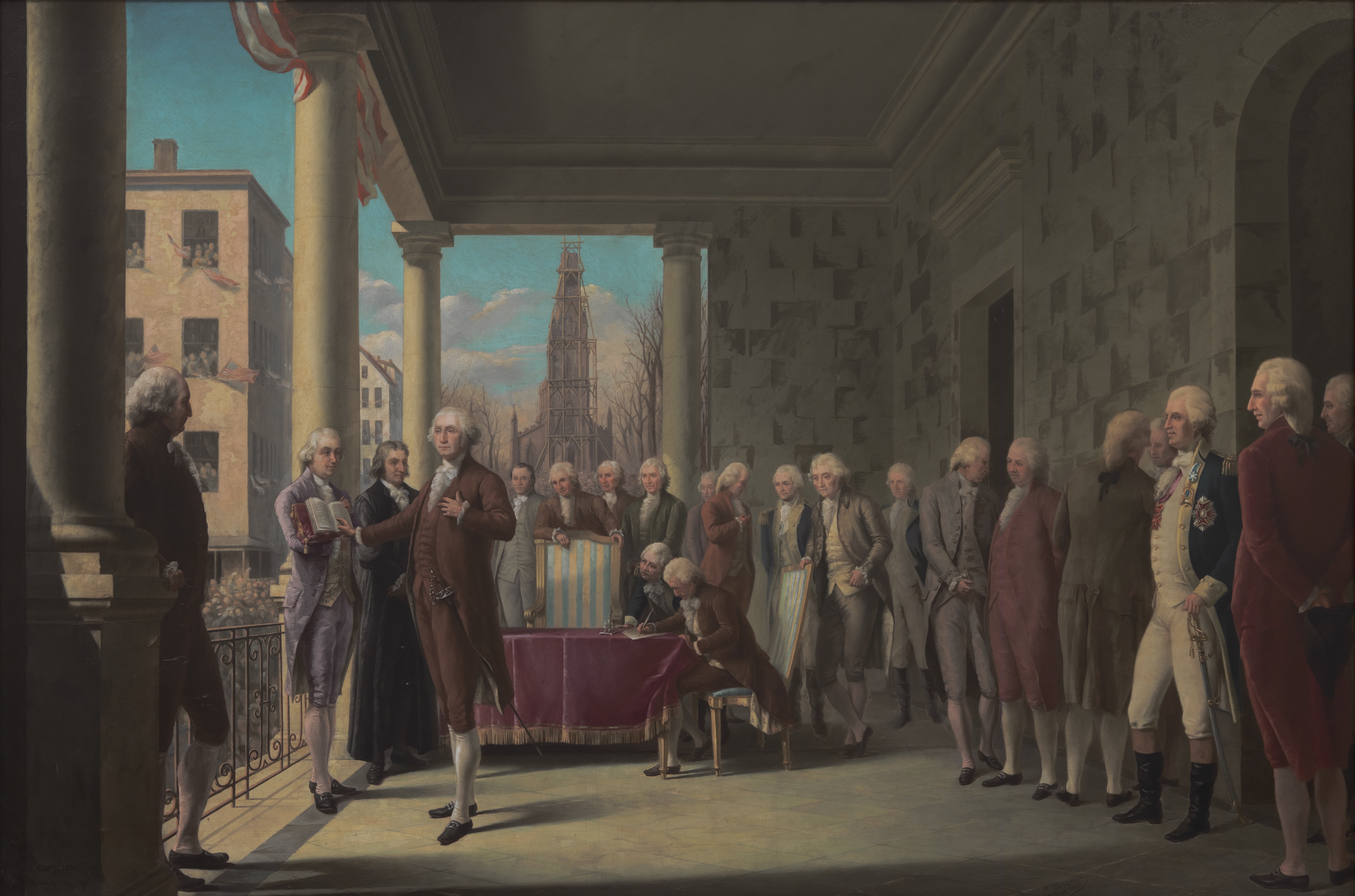
On the morning of the 30th, George Washington dressed in a suit of brown broadcloth spun in Hartford, with buttons displaying an eagle with wings spread.
The president-elect was escorted by numerous representatives to Federal Hall about half past noon. Upon arriving, he entered the Senate chamber where the two houses of Congress awaited their new head of state. Robert Livingston, Chancellor of New York, administered the oath, and Samuel Otis, Secretary of the Senate, held the ceremonial Bible.
From the portico overlooking Wall and Broad Streets, Livingston turned to the teeming streets below and shouted, "Long live George Washington, President of the United States!" After taking the oath of office on the balcony of Federal Hall, President Washington went back inside the Senate Chamber to deliver his inaugural address.
I was unable to attend to any business whatsoever; for Gentlemen, consulting their own convenience rather than mine, were calling from the time I rose for breakfast --often before-- until I sat down to dinner.
Washington to Stuart, July 26, 1789
Congratulations "not to yourself, but to my country" from Thomas Jefferson
"...permit me to express here my felicitations, not to yourself, but to my country... nobody who has tried both public & private life can doubt but that you were much happier on the banks of the Patowmac than you will be at New York. but there was nobody so well qualified as yourself to put our new machine into a regular course of action. nobody the authority of whose name could have so effectually crushed opposition at home, and produced respect abroad. I am sensible of the immensity of the sacrifice on your part. your measure of fame was full to the brim: and therefore you have nothing to gain."

Letter to the House of Representatives
"Gentlemen, Your very affectionate Address produces emotions which I know not how to express. I feel that my past endeavours in the Service of Country are far overpaid by its goodness: and I fear much that my future ones may not fulfil your kind anticipation. All that I can promise is, that they will be invariably directed by an honest and an ardent zeal. Of this resource my heart assures me. For all beyond, I rely on the wisdom and patriotism of those with whom I am to co-operate, and a continuance of the blessings of Heaven on our beloved Country."
Determining Public Forums for the President
Washington involved Congress and a close circle of advisers in the process of making his public schedule. On May 10, he delivered a questionnaire to the Senate about the appropriate public forums for the president.
Washington soon also polled the House, Secretary of Treasury Alexander Hamilton, Supreme Court Chief Justice John Jay, and diplomat Robert R. Livingston. From the outset, he tried to strike a balance, concluding that the president must "allow him[self] time for all the official duties of his station" while at the same time taking care "to avoid as much as may be, the charge of superciliousness, and seclusion." Washington used the responses to his inquiries to help create a schedule of regular public and private appearances.
Advice from Alexander Hamilton on "the demeanour of the Executive"
"Men's minds are prepared for a pretty high tone as in the demeanour of the Executive; but I doubt whether for so high a tone as in the abstract might be desirable. The notions of equality are yet in my opinion too general and too strong to admit of such a distance being placed between the President and other branches of government as might even be consistent with a due proportion. The following plan will I think steer clear of extremes and involve no very material inconvenainces."

I beg you to accept my unfeigned thanks for your friendly communications of this date-and that you will permit me to entreat a continuation of them as occasions may arise. The manner chosen for doing it, is most agreeable to me. It is my wish to act right; if I err, the head & not the heart, shall, with justice, be chargeable.
Washington to Alexander Hamilton, May 5, 1789
Letter from Cherokee Nation, Signed by 24 Native Americans
"We rejoice much to hear that the great Congress have got new powers and have become strong. We now hope that whatever is done hereafter by the Great Council will no more be destroyed and made small by any State. We shall always be ready to listen with open ears and willing hearts to you or any one joined with you and to no other for protection, and regulating all matters."
First Lady Martha Washington Arrives in the Capitol
Almost as soon as she arrived, Martha Washington was swept up in the new duties of her position. She was not only responsible for managing the presidential household but also for supervising the domestic affairs at Mount Vernon from a distance.
Each day, she was expected to dress formally, receive visitors, and make calls on important members of society. This was not how Martha would have preferred to live. Although she maintained her calm, cheerful, and dignified demeanor, she felt she was (as she told her niece) “more like a state prisoner than anything else.”

I thank god the Prdt [sic] is very well, and the Gentlemen with him are all very well, -- the House he is in is a very good one and is handsomely furnished all new for the General-- I have been so much engaged since I came hear.. I have not had one half hour to myself since the day of my arrival...
Martha Washington to Fanny Bassett Washington, June 8, 1789
Washington Supports Madison's Bill of Rights
James Madison faced skepticism in the Federalist-dominated Congress that the amendments, originally an Antifederalist idea, were necessary. President Washington wrote a letter to Madison, which was shared in Congress, that the amendments "have my wishes for a favorable reception in both houses."

As far as a momentary consideration has enabled me to judge, I see nothing exceptionable in the proposed amendments. Some of them, in my opinion, are importantly necessary; others, though of themselves (in my conception) not very essential, are necessary to quiet the fears of some respectable characters and well meaning men. Upon the whole, therefore, not forseeing any evil consequences that can result from their adoption, they have my wishes for a favourable reception in both houses.
Washington to James Madison, May 31, 1789
Day 50
First Bill Under the Constitution is Passed
The president signed the first bill passed under the Constitution, a measure to regulate the administration of oaths.
Gets a Full Account of the Domestic Debt
The Board of the Treasury apprises President Washington of the current financial situation of the new nation.

Washington Library Director Douglas Bradburn on the Economy After the Revolutionary War
Bacterial Infection Requires an Emergency Surgical Procedure
In mid June, President Washington develops a severe fever which is soon attributed to an emerging growth on his left thigh. He was seriously ill for several weeks, although the extent of his incapacitation was not shared publically.
Washington was under the care of Dr. Samuel Bard, one of the city's leading physicians. Dr. Bard initially diagnosed the president's illness as anthrax, and ultimately determines that the tumor would require surgery immediately.
Aided by his father, Dr. John Bard, the operation was conducted on June 17, 1789. The president responded well to Bard's treatment, although he remained confined to his bed and suffered from severe weakness. It was not until almost a month later that Washington was able to return to business at a reduced capacity. On July 3, Washington writes: "... my health is restored, but a feebleness still hangs upon me."

Tariff Act of 1789
Congress spent much of June and July of 1789 working to establish sources of revenue for the new government. On the symbolic date of July 4, President Washington signed the Tariff Act of 1789. The law placed a five percent tax on all imports.